How Are Copper-Finish Stainless Steel Sheets Made for Architectural Projects?
Table of Contents
Copper has always been a commonly used decorative material in hotel lobbies, restaurants, commercial spaces, clubs, high-end residential buildings, and building facades.It has a warm metallic color, and over time, it can also form a unique oxidation and aging effect.
But in actual projects, designers do not necessarily need to use real copper plates. Material weight, processing method, surface effect, maintenance requirements, and project budget may all affect the final material selection. Therefore, more and more projects are beginning to use stainless steel as the substrate, and the visual effect close to copper is obtained through surface treatment.
This is the basic idea of Copper-Finish Stainless Steel Sheets.
However, the production ofcopper-imitated stainless steel for construction projects is far more than simply doing a layer of copper-colored treatment on the surface of the stainless steel plate.The final effect depends on the substrate, surface treatment, color control, aging process, and subsequent protection treatment.
Especially for customized projects, the final effect seen by customers is actually a large part of the material and process selection in the early stage.
Substrate Selection for Copper-Finish Stainless Steel
The first step in making copper-finish stainless steel is not to make the color, but to determine the appropriate stainless steel substrate.
Common materials include 304 and 316 stainless steel. For hotels, restaurants, interior walls, door covers, screens, and other interior decoration items, 304 can usually already meet the requirements for use. If the project is located in a coastal area, or in an environment with high humidity and salt spray for a long time, 316 stainless steel needs to be considered according to the actual environment.
The thickness of the plate can also not be determined only based on the surface effect.
If the product is only used as a flat decorative board, the appropriate thickness can be selected according to the size and installation structure. If subsequent bending, edging, welding, or making into door covers, column covers, and three-dimensional decorative components are required, then the material thickness needs to be determined together with the processing method.
For large-scale construction projects, the size of a single slab also needs to be considered in the early stage. The larger the plate, the requirements for transportation, processing, on-site handling, and back support will change. Therefore, copper-finished stainless steel for architectural projects usually needs to be considered in terms of material, size, and installation method, rather than determining a “copper color” separately.
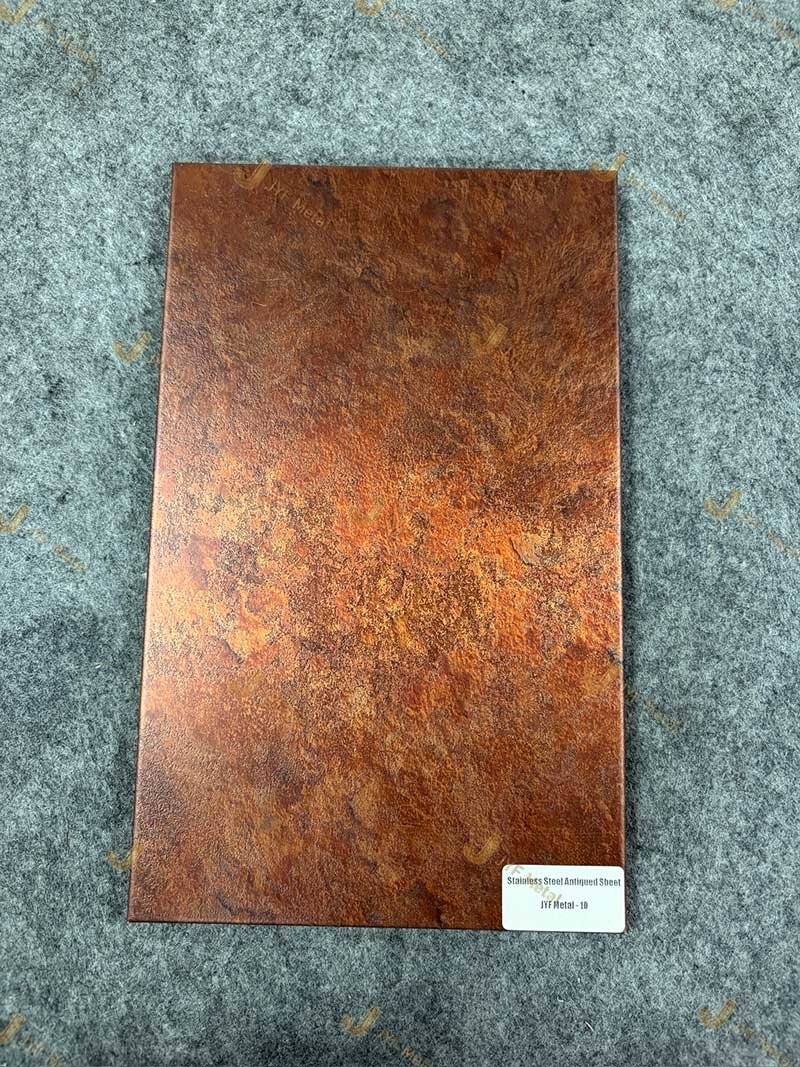
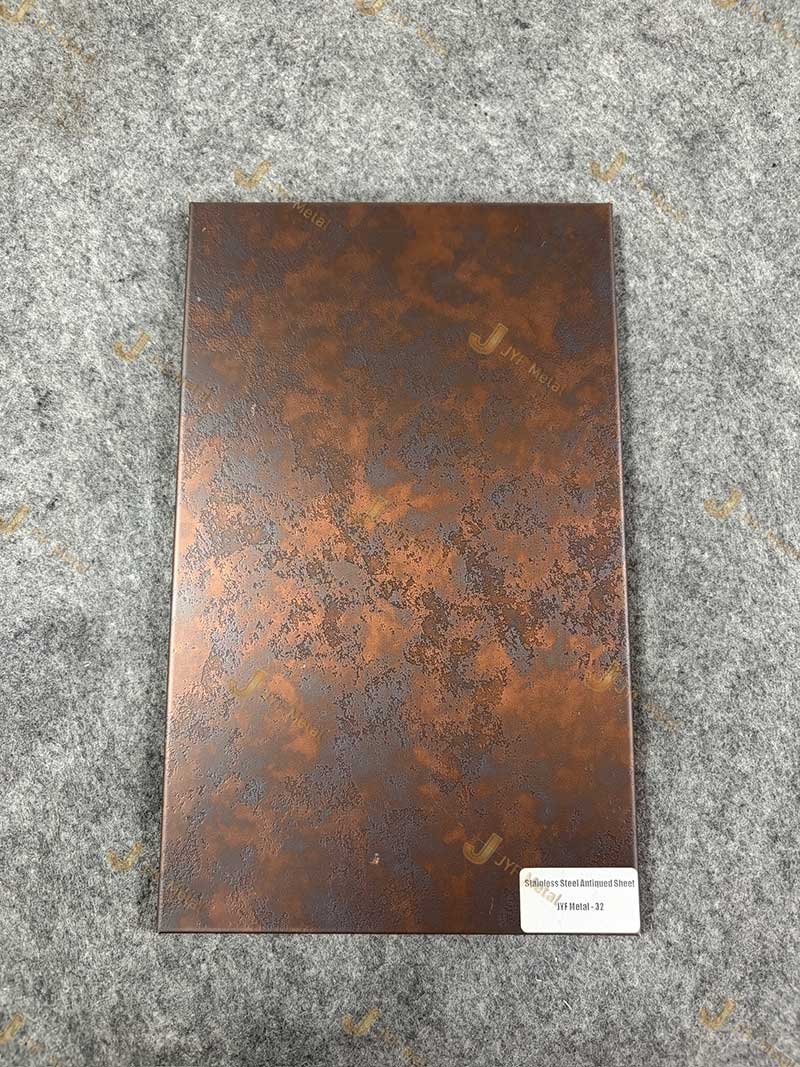
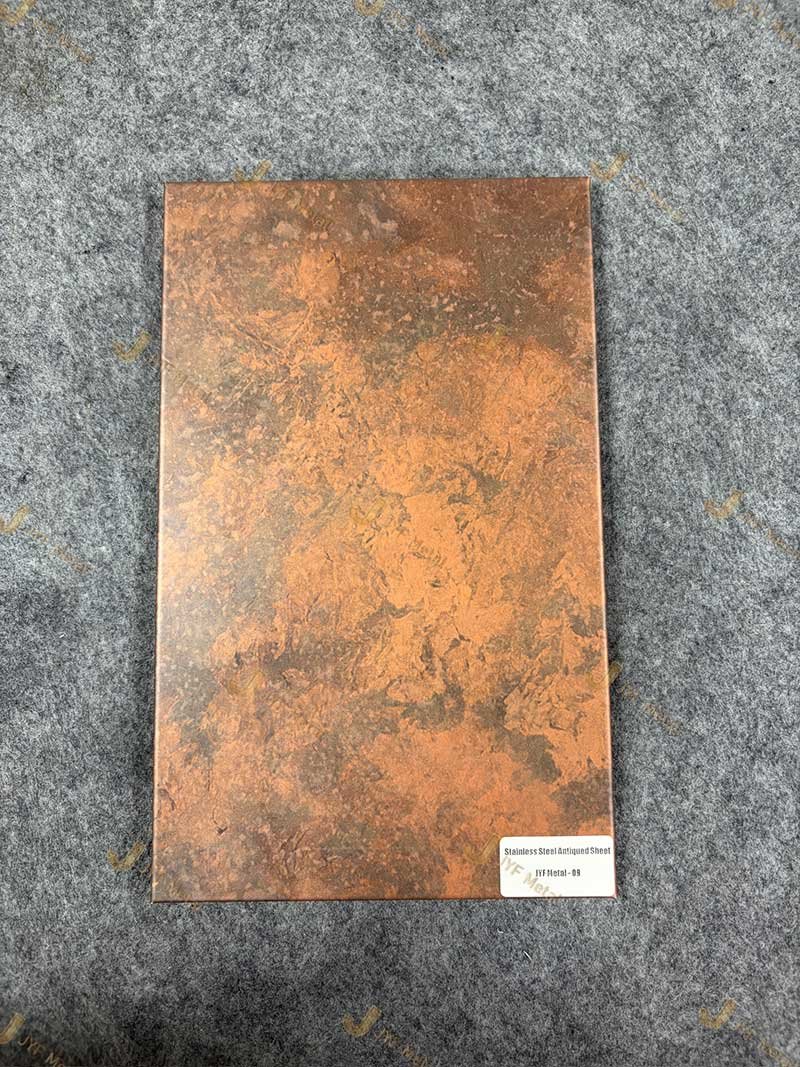
How Surface Finishing Shapes Copper-Finish Stainless Steel
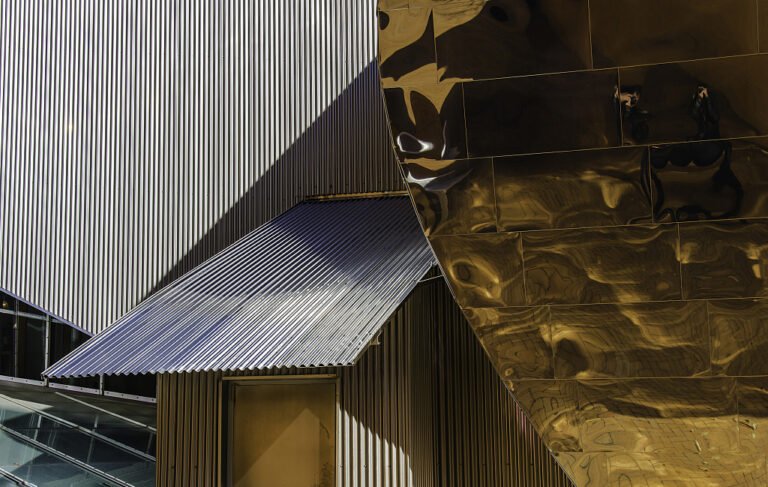
Stainless steel itself does not have the color of copper, so before entering the copper imitation process, the basic surface needs to be determined first. Different stainless steel surfaces will produce different visual effects. For example, the specular surface has a strong reflection effect, the brushed surface will retain a significant linear texture, while sandblasting or other matte treatment can reduce the reflection and make the surface softer.
Therefore, the same imitation copper color is applied to different substrates, and the final effect may be different.
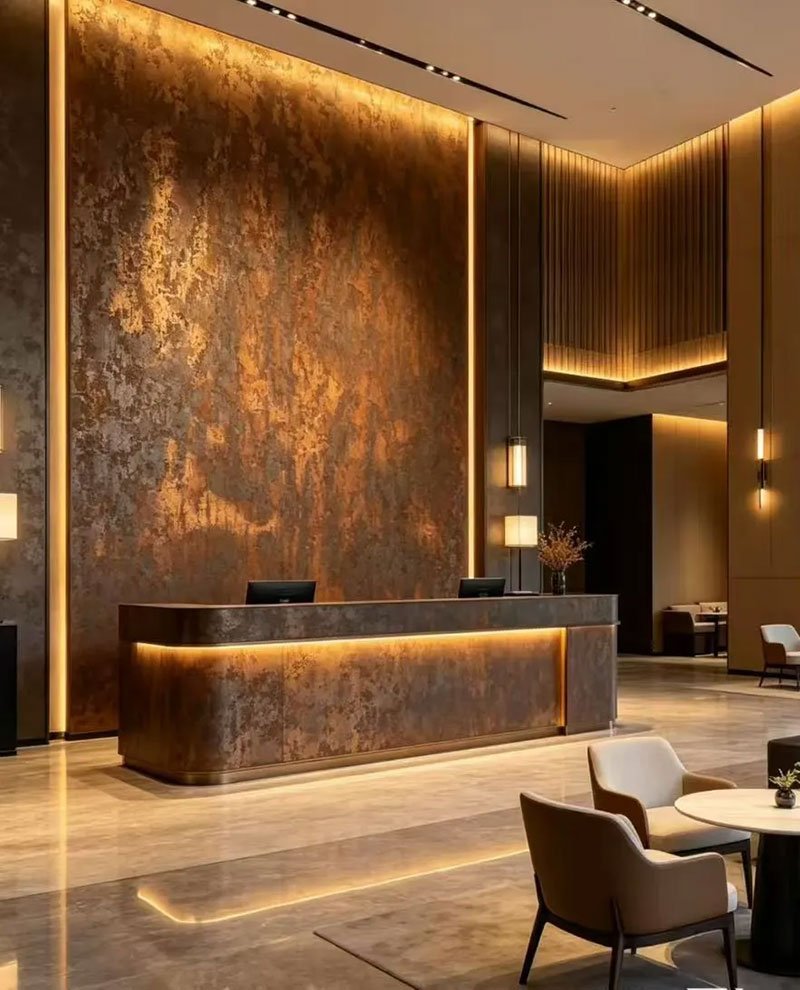
For copper-look stainless steel panels, the surface treatment not only affects the color, but also the way light is reflected on the surface of the plate. Especially in hotel lobbies, commercial spaces and large background walls, lighting usually directly affects the visual effects of metal surfaces, so the final texture cannot be judged only based on computer renderings.
Before formal production, the factory needs to determine the basic surface according to customer requirements, and then enter the subsequent imitation copper treatment.
The Dynamic Color Spectrum of Copper-Finish Stainless Steel
Copper-finish stainless steel panels can achieve many different visual effects.
If the project requires a more modern metallic copper color, the surface will usually be more uniform, with the focus on maintaining a balance between color and metallic luster.
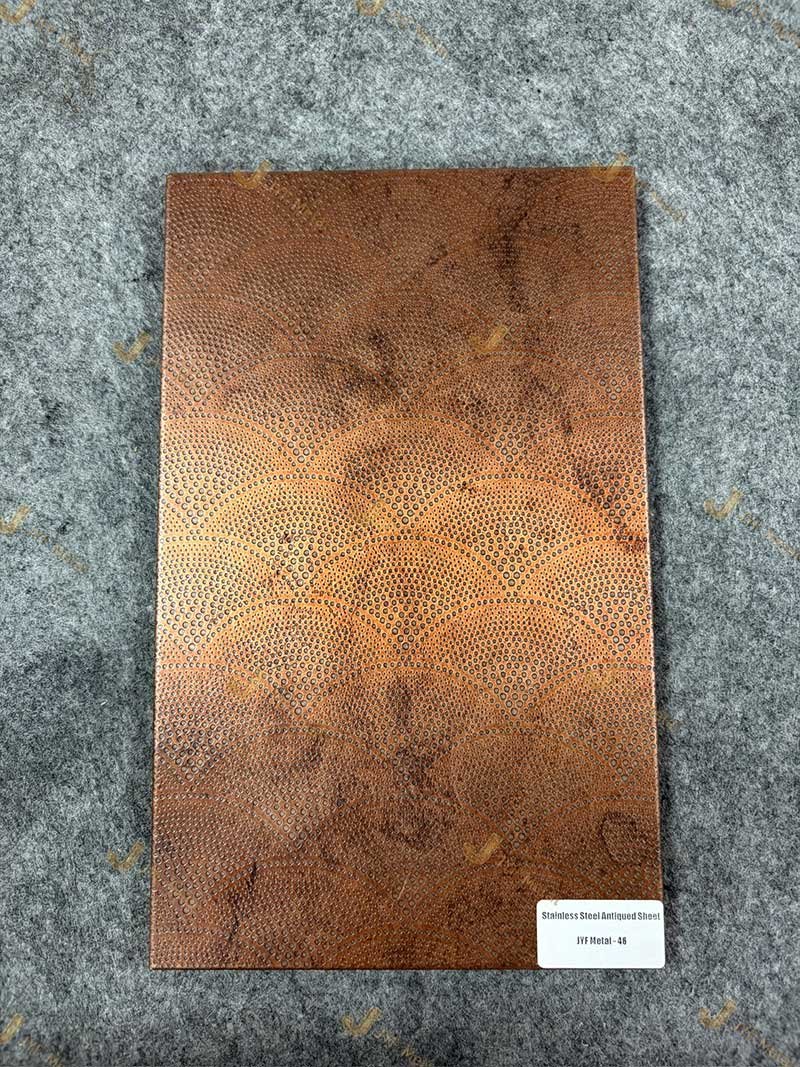
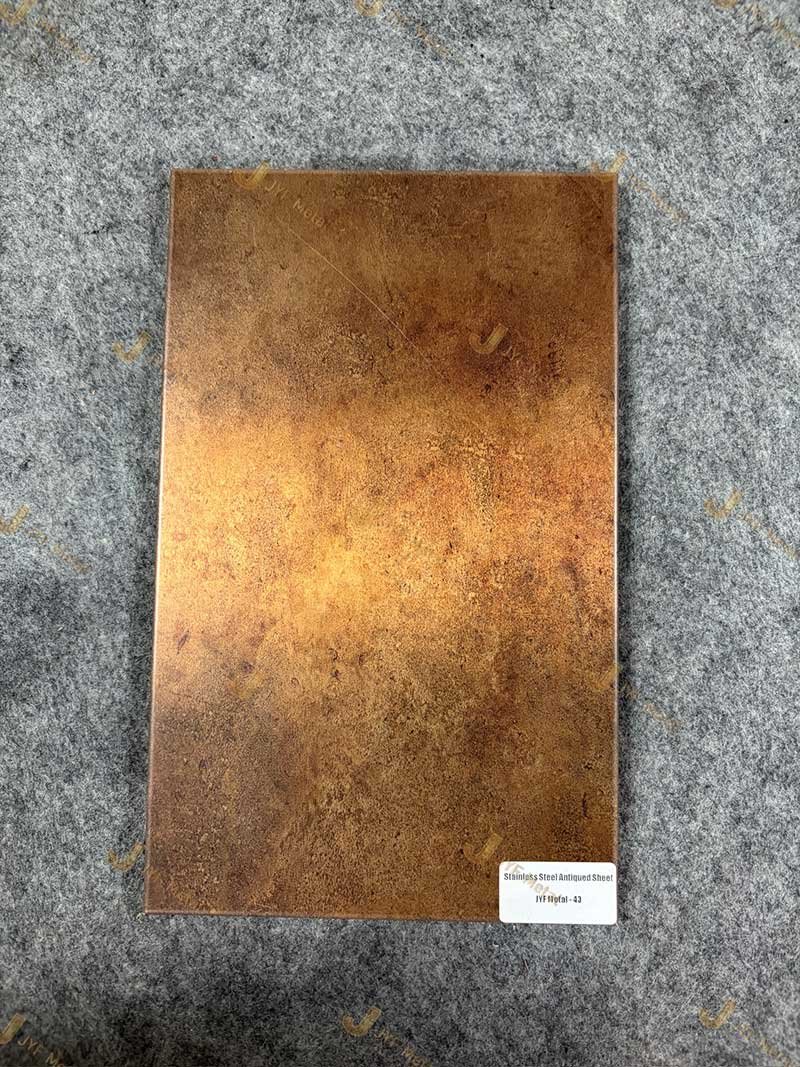
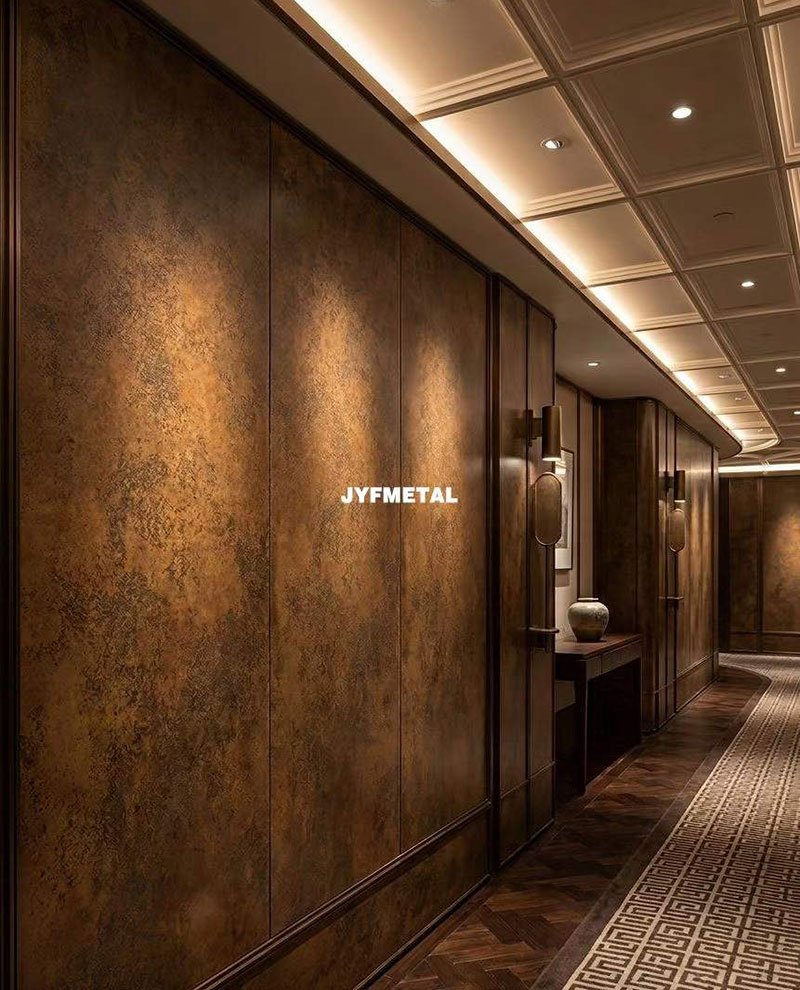
If the design requires a bronze effect, more depth changes will be added to make the surface look less like a completely uniform new material. For antique copper stainless steel sheets, the color can show different degrees of dark areas, light areas, and natural color changes according to the design requirements.
If the customer needs a more obvious aging effect, the surface can further increase local changes, so that the plate has a similar sense of layering after time oxidation.
There is a very important difference here:
Copper-finish stainless steel andantique copper stainless steel are not the same surface effect.
The former emphasizes color consistency and modernity, while the latter emphasizes color layering and natural changes.
Therefore, in customized projects, it is usually not enough to just tell the factory “I want Copper”. It is best to provide a physical model, a clear reference picture, or explain the specific effects of new copper, old copper, deep bronze, matte copper, etc. that you want to achieve.
Sample Approval Is An Important Step In Determining The Final Effect
For custom copper-finish stainless steel sheets, sample approval is usually more reliable than production directly based on photos.
This is because the visual effect of the metal surface will be affected by many factors, including lighting, viewing angle, substrate surface, shooting equipment, and display.
Especially the antique copper effect, the color change in the same photo does not fully represent the actual plate.
Therefore, before mass production, small samples can be made according to project requirements. The focus of the model confirmation is not to simply judge “whether it is copper color”, but to confirm the design language of the entire surface, including color depth, gloss, metal reflection, degree of aging, and texture performance.
Once the model is confirmed, it can become an important reference standard for subsequent production.
For the same construction project, if the order quantity is large, or it needs to be produced in batches, it should also be produced in accordance with the same set of confirmation standards as much as possible. This can reduce the risk of significant visual differences between different batches.
Fabrication Considerations for Copper-Finish Stainless Steel
Copper-Finish stainless steel is not necessarily installed on the wall in the form of an ordinary flat plate in the end.
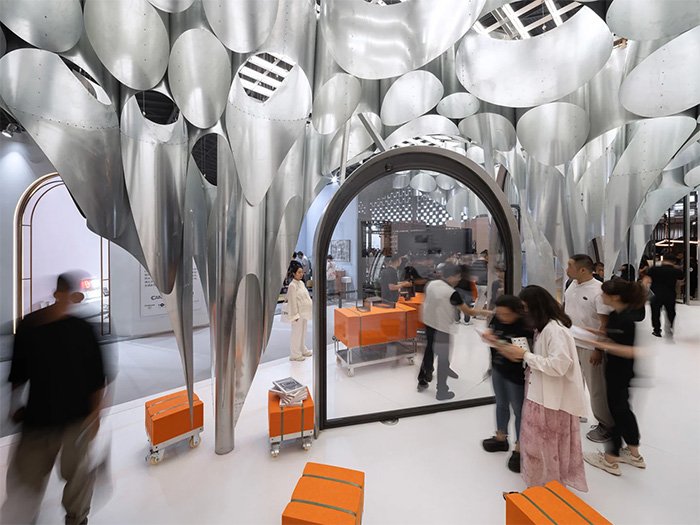
In construction projects, it is often necessary to process the plates into wall panels, column covers, door covers, elevator door covers, ceilings, screens, decorative tile trims or other customized metal structures.
This means that the production sequence needs to be planned in advance.
For example, if a sheet needs to be bent on all sides, the bending size needs to be determined in advance; if the frame or reinforced structure needs to be welded, the relationship between the welding position and subsequent surface treatment needs to be considered.
For some complex components, the factory also needs to laser cut, open holes, bend, weld, polish and assemble according to customer drawings.
If the product eventually needs to present a completeimitation copper surface, then these processing steps cannot be arranged at will. Because different processing methods may affect the continuity and final appearance of the surface.
Therefore, the production of stainless steel sheets with copper finish is actually not only a surface treatment project, but also ametal processing project.
Pricing Copper-Finish Stainless Steel Beyond Rendering Limitations
For ordinary standard plates, a basic quotation can usually be prepared once the size and quantity are provided.
But for customized imitation copper projects, the situation is usually different.
An architectural rendering can only tell the factory what kind of visual effect the product wants to present in the end, but it cannot fully explain how it is actually produced.
For example, it is also an imitation copper background wall, which may be installed directly with a flat plate, or it may be a curved box plate, a plate with a reinforced structure on the back, or even a complete metal frame may need to be made.
Different structures will directly affect the amount of materials, processing steps, welding volume, packaging methods and transportation costs.
Therefore, if the customer already has detailed drawings, it is best to provide the size, thickness, quantity, bending requirements, installation method and surface reference of the sheet at the same time.
If there are only renderings, you can also conduct a preliminary evaluation first, and then confirm the final production plan based on the deepening drawings.
This is whycustom copper-finish stainless steel projects usually need to be considered together with design, processing and surface treatment.
Why Modern Architecture Prefers Copper-Finish Stainless Steel to Real Copper
For building decoration projects, choosing copper-finish stainless steel does not necessarily mean completely replacing real copper.
First of all, it is necessary to clarify whether what the project really needs is the material properties of the copper itself, or the visual effects such as copper, bronze, and old copper.
If the design focuses on the color of the surface, the metallic texture and the overall decorative effect, thenCopper-Finish Stainless Steel Sheets can be used as a feasible material solution.
In the actual project, it is also necessary to consider the processing method, the weight of the sheet, the use environment and the installation conditions comprehensively.
For example, large-area wall panels, cylinders, door covers, screens, and other customized metal structures usually need to be cut, bent, welded, or assembled.
These requirements will affect the final material choice. At the same time, the indoor and outdoor environment, sheet thickness, back structure and transportation methods also need to be considered together in the early stages of the project.
Therefore, choosing between copper-finish stainless steel and real copper should not be based only on the material or unit price, but also on the final surface effect, processing requirements, project environment, and overall construction conditions.
For construction projects that require copper visual effects and contain more customized metal processing, copper-finish stainless steel can provide another more flexible material solution.
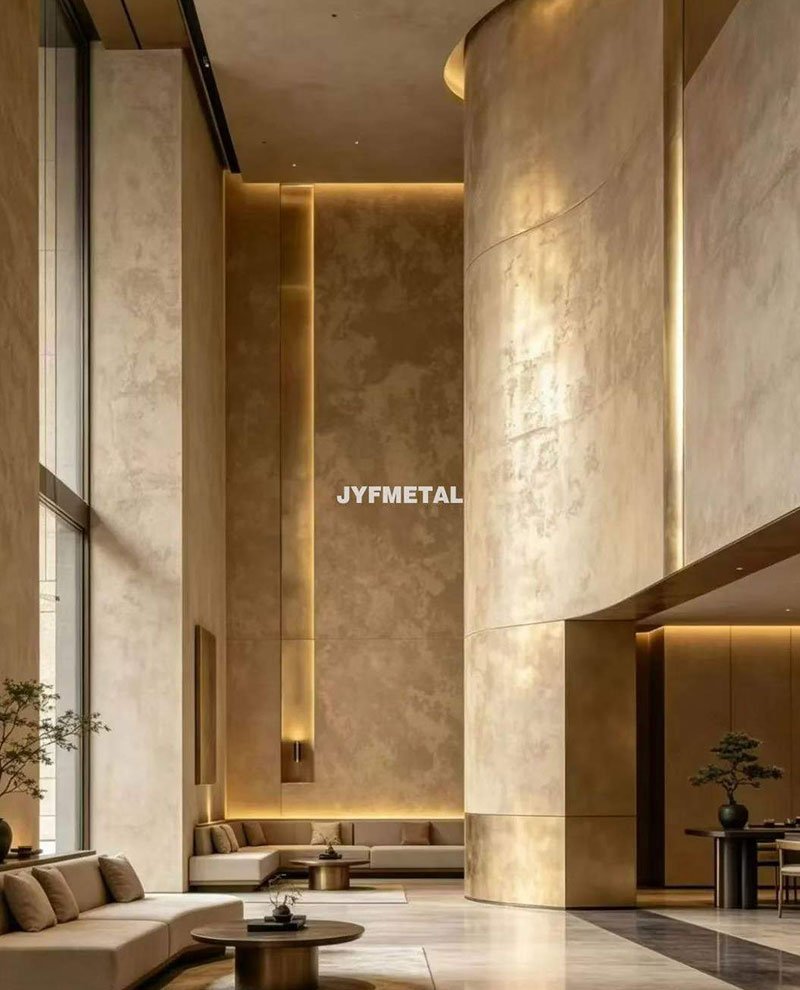
JYF METAL’s Tailored Workflow for Copper-Finish Stainless Steel
At JYF METAL, copper-finish stainless steel projects usually start with the customer’s end-use scenario rather than a fixed color.
First confirm whether the project is indoor or outdoor, whether 304 or 316 is used, how thick the sheet needs to be, and what kind of surface effect is required in the end.
Then according to the pictures, samples or design requirements provided by the customer, confirm the basic surface and copper imitation effect.
If the project involves bending, welding, strengthening the structure or complex dimensions, the processing method needs to be further combined with the drawings.
For projects with high requirements for color and aging effect, you can first make a model for confirmation. After the model is determined, it will enter mass production according to the confirmed effect.
This method is more suitable for hotels, commercial spaces, restaurants, clubs, residences, and other customized projects that require copper-finished stainless steel for architectural projects.
The ultimate goal is not to simply make stainless steel “look like copper”, but to ensure the surface effect while allowing the material to truly meet the processing, transportation and installation requirements of the project.
Frequently Asked Questions
Q1: Is copper-finish stainless steel a real copper plate?
No. It uses stainless steel as the substrate, with copper, bronze, or aged copper effects created through the corresponding surface treatment.
Q2: Can the bronze color specified by the customer be made?
It can be evaluated according to the reference pictures, physical samples or design requirements provided by the customer. For projects with high color requirements, it is recommended to confirm the model first.
Q3: Can copper-finish stainless steel be used for outdoor projects?
Yes. However, the appropriate stainless steel grade and surface treatment should be selected based on the project environment, installation location, and specific installation conditions.
Q4: Can copper-finish stainless steel be processed into special-shaped parts?
Yes, it can. According to the design, customized processing such as laser cutting, bending, welding, polishing, and assembly can be carried out.
Q5: How to control the color during mass production?
The most reliable way is to confirm the actual model before production, and use the confirmed model as a reference standard for subsequent production, rather than just relying on the picture or color name on the screen.