How to Make Antique Stainless Steel Sheets That Are Truly Suitable for Construction Projects?
Table of Contents
For hotels, restaurants, commercial spaces and high-end residential projects, stainless steel distressed plates do not simply turn stainless steel plates into a “retro color”.From the selection of raw materials, to surface texture, aging treatment, color control, to subsequent processing, packaging and on-site installation, every link will affect the final decorative effect.
When many customers purchase antique stainless steel sheet, the first concern is whether the color meets the design effect.However, in actual projects, the real problems that are prone to problems include color batch differences, surface scratches, wrong texture direction, plate deformation, obvious patchwork, and mismatched on-site installation dimensions.
Therefore, for customized stainless steel aging projects, you can’t just look at a sample, but should consider it as a whole from production to installation.
How is the Antique Stainless Steel Sheet Produced ?
How to choose between stainless steel and 316 stainless steel?
304 stainless steel sheet is a more common material in interior decoration projects and can be used in hotels, restaurants, commercial spaces, door covers, walls, ceilings, and furniture decoration.
If the project is located in a coastal area, a humid environment, or an outdoor area, further evaluation is required 316 stainless steel sheet.The choice of materials cannot only depend on the unit price, but also needs to be combined with the project environment, service life and maintenance requirements.
Why does stainless steel surface finish affect the antique effect?
Before performing the aging treatment, the original surface of the stainless steel needs to be determined first.
Common stainless steel surface finish includes:
- Brushed Stainless Steel
- Hairline Finish
- Mirror Finish
- Customized brushed texture
If the same old color is applied to different surface textures, the final reflective effect may be completely different.
For example, it is also bronze, with a brushed board and a high-gloss board, which may have completely different visual effects under the hotel spotlight.
How was Antique Finish Formed?
The focus of antique finish is not to simply change the color of stainless steel, but to form a layered aging effect through surface treatment.
According to the design requirements, the color depth, surface texture, and overall uniformity can be controlled.
If the project area is large, it is recommended to make a sample panel before mass production to confirm the actual color and surface effect.
How is the Color of the Antique Stainless Steel Sheet Made ?
Is PVD coating the only way to color stainless steel?
It is not.
PVD coating is a more common process in the coloring of stainless steel surfaces, which can form different effects such as gold, champagne, black, and bronze.
However, the effect of PVD is not exactly the same as that of aging in the traditional sense.
PVD coating focuses more on forming a stable surface color, while antique finish emphasizes the sense of aging, color level, and visual changes on the surface.
The specific process used needs to be determined according to the design effect and the project use environment.
Why is there a difference in the production of the same color?
The color of the metal surface is not a completely independent variable.
The following factors will affect the final visual effect:
- Raw material batch
- Surface texture
- Drawing direction
- Surface treatment process
- Degree of aging
- Light angle
- On-site lighting color temperature
Especially in hotel lobbies, restaurants and commercial spaces, the visual effects of the same metal surface may vary under different lighting environments.
Therefore, for customized colors, it is recommended to use approved sample as a reference standard for mass production.
How to control color consistency for large-area projects?
If a project requires dozens or even hundreds of square meters of antique stainless steel panels, it is best to confirm it uniformly before production.:
- Material
- Thickness
- Surface Finish
- Color
- Antique Effect
- Gloss
- Grain Direction
If the project needs to be produced in batches, it is also necessary to consider the color control between different production batches in advance.

How are Custom Antique Stainless Steel Panels Processed?
Why can’t building decoration projects only be produced according to flat panels?
Custom stainless steel panels in construction projects are usually not simple flat panels.
According to the design requirements, the sheet may need to be carried out:
- Cutting
- Bending
- Folding
- Welding
- Edge Forming
- Reinforcement
For example, for a wall decoration box, what you finally see is a complete plane, but the actual production of the factory also needs to consider the hemming, back structure, connection method and on-site installation space.
Why is shop drawing important?
For customized projects, shop drawing can help factories and customers confirm the actual production size in advance.
It’s best to be clear in the drawings:
- Panel No.
- Finished Size
- Developed Size
- Bending Position
- Edge Detail
- Installation Method
- Reinforcement
- Grain Direction
Especially for door covers, column-clad panels and large-scale wall decorative panels, if they are only produced according to the renderings, they are prone to size and installation problems in the later stage.
Why do large-size panels need to be strengthened on the back?
When the size of the plate increases, it is not only the panel itself that needs to be considered, but also the stability during transportation and installation.
According to the size and structural requirements, the reinforcement frame can be added to the back or the structure can be strengthened to reduce the risk of deformation of the sheet during transportation and installation.
For large-scale hotel wall or commercial space projects, hoisting, packaging and on-site handling conditions also need to be considered at the same time.
How Should Antique Stainless Steel Wall Panels be Installed?
What do I need to check before installation?
Before installing antique stainless steel wall panels, you need to check the on-site infrastructure.
Main confirmation:
- Whether the wall is flat;
- Is the base layer firm?;
- Is the keel position accurate?;
- Whether hidden projects such as hydropower are completed;
- Whether the actual on-site dimensions are consistent with the drawings;
- Whether to reserve installation space.
If the base layer error is large, even if the factory production size is accurate, the height difference and patchwork problems may occur after on-site installation.
What is the difference between mechanical fixing and adhesive fixing?
Mechanical Fixing The panel is usually fixed by screws, bolts or connectors, which is suitable for installation scenarios that require high structural stability.
Adhesive Fixing is installed through adhesive materials suitable for metal decorative panels, which are more suitable for some interior decoration applications.
For large-scale custom metal wall panels, you can also use the frame system, first complete the back frame, and then install the panel on the structure.
The specific method needs to be determined according to the panel size, weight, base layer and project requirements.
Why are panel layout and grain direction important?
One of the most overlooked problems of large-area metal decoration is the direction of texture.
Assuming that the three panels use exactly the same color, and the texture direction of one of them changes, it may look like different colors after the installation is complete.
Therefore, in the production, packaging and installation stages, you can follow:
Panel No. + Installation Location + Grain Direction
Make a number.
In this way, on-site installers can install according to the numbers and drawings, reducing mis-installation and rework.
What are the Most Common Problems During the Installation Process?
Why does the color feel different after installation?
This does not necessarily mean that there is a quality problem with the product.
The metal surface is reflective, and when the same plate is viewed from different angles, the brightness and color perception may change.
If there is a so-called “color difference” on the scene, it should be checked first:
- Observation angle;
- Light direction;
- Light color temperature;
- Texture direction;
- Product production batch;
- How to compare the model with the actual product.
Therefore, the color confirmation is best based on the physical model and the actual project environment as a reference.
Why is the surface prone to scratches?
Although stainless steel has good durability, after special surface treatment, the decorative surface still needs to be protected.
Common sources of scratches include:
- Direct friction between plates;
- Collision during handling;
- Insufficient packaging protection;
- Installation tool contact surface;
- Other types of construction work have not done a good job of protecting finished products.
Therefore, the protective film, packaging method, and on-site protection of finished products are all part of the project quality control.
Why is the patchwork particularly obvious after installation?
Patchwork problems are usually buried before installation.
If there is no reasonable planning panel layout in the production stage, and then temporarily cut according to the actual size after arriving at the site, it is easy to have problems such as uneven patchwork width and continuous texture.
For hotel lobbies and high-end commercial spaces, it is recommended to determine the plate division plan before production, rather than leaving all problems to the site to solve.
Why is the effect of the bending position different from the plane?
For customized panels that need to be bent, you cannot only confirm the flat model.
The bending radius, processing method, corner structure, and surface texture may all affect the visual effect of the bending area.
Therefore, if the project contains a large number of bending products, it is best to confirm the actual effect after bending at the model stage.
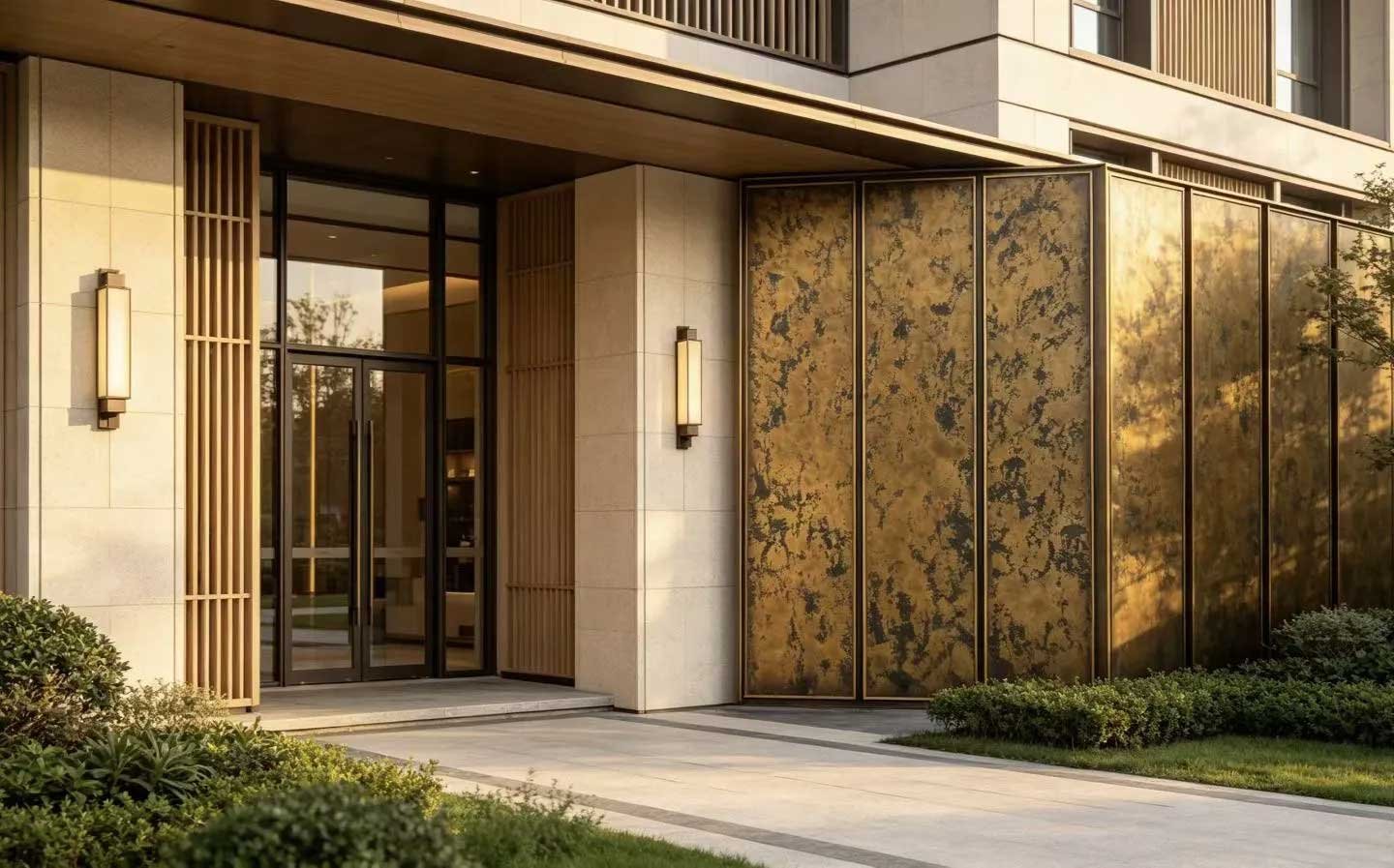
How to Control the Overall Quality of Antique Stainless Steel Sheet Projects?
First confirm the model, then confirm the mass production standard
For custom antique stainless steel panels, sample confirmation should be an important part before formal production.
Customers need to confirm not only the color, but also:
Color + Texture + Gloss + Antique Effect + Grain Direction
If only the color is confirmed, but the surface texture and degree of aging are not confirmed, disputes may still arise in the later stage.
Confirm all installation details before production
For customized projects, it is recommended to complete shop drawing approval before production.
Confirming the size, bending, patchwork, installation method and reinforced structure in advance can reduce on-site modification and rework.
Packaging will also affect the final effect
For high-end metal decoration products, the transportation process from the factory to the project site also requires quality control.
Need to avoid:
- Friction between plates;
- Heavy objects are pressed on the panel;
- The corners are hit;
- The packaging is damp;
- Deformation occurs during handling.
Especially for large-size panels, reasonable packaging and support methods need to be designed according to the actual size and weight.
Production and installation should be considered as a whole
Truly reliable metal decoration projects should not be simply understood as “the factory is responsible for production and the site is responsible for installation.”
From design, materials, surface treatment, processing, numbering, packaging to on-site installation, every link will affect the final effect.
For customized products such as custom metal wall panels, the earlier the project details are confirmed, the lower the probability of problems later.
Conclusion
The final effect of stainless steel aging board comes from the common control of multiple links, not just the choice of one color.
From the selection of 304 stainless steel sheet or 316 stainless steel sheet, to antique finish, surface color and texture treatment, to custom stainless steel panels processing, packaging and on-site installation, every link needs to be linked to the final project effect.
Especially for large-scale decoration projects in hotels, restaurants and commercial spaces, it is recommended to complete the model confirmation, drawing confirmation and installation method confirmation before the official production.
Only by considering production and installation as a complete project can color, texture, size, patchwork and on-site effects be better controlled.
Frequently Asked Questions
Can the color of the Antique Stainless Steel Sheet be customized?
Yes.The color, surface texture, gloss and degree of aging can all be confirmed according to the project requirements.For special colors, it is recommended to make sample panel first.
Can antique stainless steel panels be used for hotel projects?
Can common applications include hotel lobby walls, restaurant background walls, bars, corridors, ceilings, door covers and cylinders.
Is antique finish the same as PVD coating?
Not exactly the same.PVD coating is mainly used to form surface colors, while antique finish emphasizes aging effects, textures, and color levels.The specific process needs to be determined according to the effect of the project.
Can antique stainless steel wall panels be enlarged?
It can be customized according to project requirements, but the larger the size, the higher the requirements for sheet thickness, back strengthening, packaging and transportation, and on-site installation.
How to avoid the color difference of antique stainless steel plates?
It is recommended to confirm the approved sample before mass production, and at the same time unify the material, surface texture, color standard, degree of aging and production process.
Do you need drawings for the installation of stainless steel antique copper plates?
For standard products, complex drawings are not necessarily required, but for customized products such as wall panels, door covers, column covers, etc., it is recommended to provide and confirm shop drawing, and determine the size, patchwork and installation structure in advance.
What should I do if there are scratches on the surface of the antique patina stainless steel plate?
First of all, it is necessary to judge whether the scratches are produced during production, transportation or on-site construction.The repair methods corresponding to different surface treatments are different. It is not recommended to polish the surface of ordinary stainless steel directly, otherwise the original color and texture may be changed.