Metal Architectural Engineering Solutions: Stainless Steel Antique Verdigris Sheet
Table of Contents
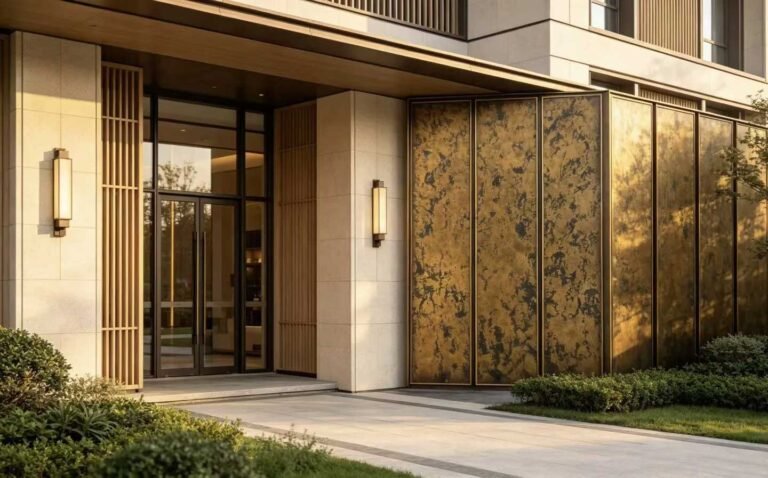
In contemporary commercial architecture and high-end interior design, the verdigris copper effect can give a distinctive historical depth and natural texture to distinctive walls, entrance door frames, and landscape artworks. Traditionally, to achieve a rich aged green copper effect, pure copper sheets were used and relied on the long-term atmospheric weathering. However, pure copper faces serious structural and chemical flaws in modern large-scale commercial development: extremely high material costs, excessive self-weight, low tensile strength, and uncontrollable green oxides that constantly flow and contaminate the exterior facades of surrounding buildings over time.
To address these construction challenges, JYF METAL customizes stainless steel antique verdigris sheet. Stainless steel is strength, easy to fabricate into shape and performs well in fire. On the base material, controlled chemical oxidation and copper electroplating recreate the appearance of aged green copper fairly faithfully — but without the loss in structural performance, and without the open-ended upkeep costs that real copper brings once it is installed on site.
The guide below is written mainly for architects, curtain wall consultants and buyers who need to source good-quality stainless steel antique verdigris sheet for commercial projects. It is laid out as a practical engineering specification reference rather than a marketing brochure.
Material Selection & Verdigris Patination Chemistry
The green finish used on architectural panels is produced by chemically oxidising a layer of copper bonded to a good-quality stainless steel sheet. The material chosen and the way the patina is applied largely decide how long the panel holds up and how convincing the aged look is.
01
Choosing the base material
(AISI 304 for indoor use; AISI 316L for outdoor and coastal sites)
↓
02
Copper plating layer
(High adhesion deposition of pure copper)
↓
03
Controlled chemical patination
(Acid treatment that turns the surface into copper carbonate)
↓
04
Clear UV-cured sealant coat
(Holds the patina in place and stops green runoff)
Choosing Material: AISI 304 VS AISI 316L
Since the underlying stainless steel provides the true structural foundation of the cladding sheet, choosing the correct alloy grade is vital for preventing subsurface corrosion.
AISI 304: With roughly 18% chromium and 8% nickel, this is the grade normally used for interior architectural work. It is ductile and strong, and it suits indoor feature walls, reception backdrops, column covers and elevator lobby details — anywhere the humidity stays controlled.
AISI 316L: This material adds 2–3% molybdenum and uses a lower carbon content, which gives it noticeably better resistance to chloride pitting, coastal air and industrial pollution. It should be specified for exterior cladding, outdoor landscape art, seaside resorts and damp interior settings such as luxury spas, so the steel core stays sound even with moisture in the air.
Controlled Electroplating of Copper and Acid Oxidation Reaction
Ordinary green patina or a printed pattern cannot really pass for aged verdigris. To get genuine depth, JYF METAL builds the finish electrochemically in several stages:
Copper electroplating: A layer of pure copper is electrodeposited onto the stainless steel sheet so that it forms a metallic bond with the substrate.
Acid patination: The copper-plated sheet goes into a chamber where temperature and humidity are controlled, and is treated with acidic formulations made up of copper salts, carbonates and oxidising agents.
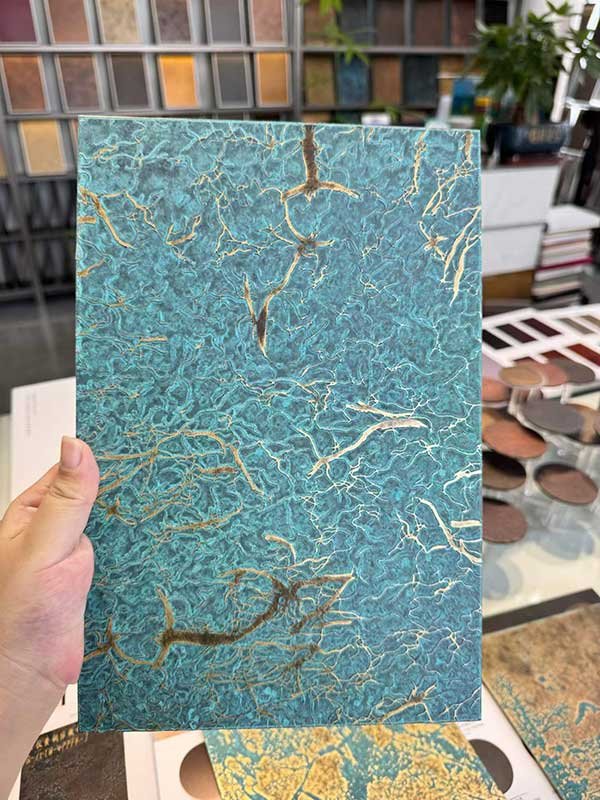
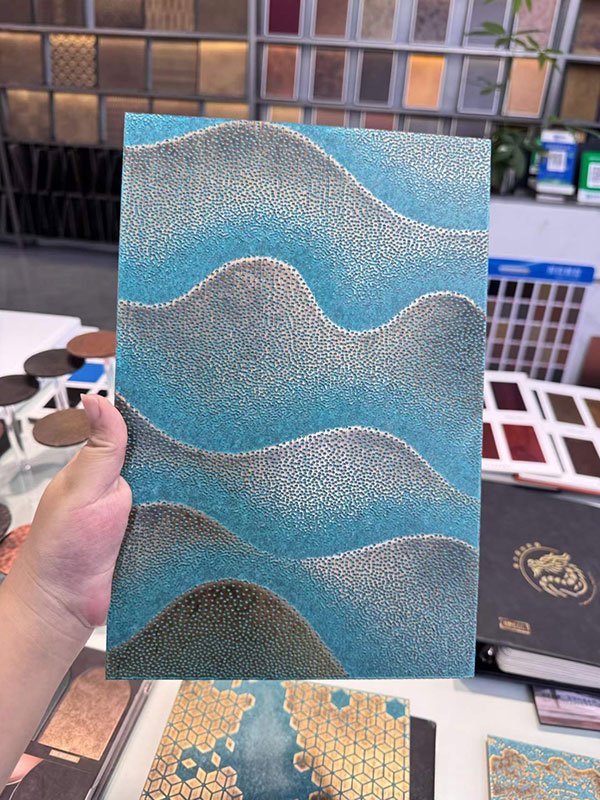
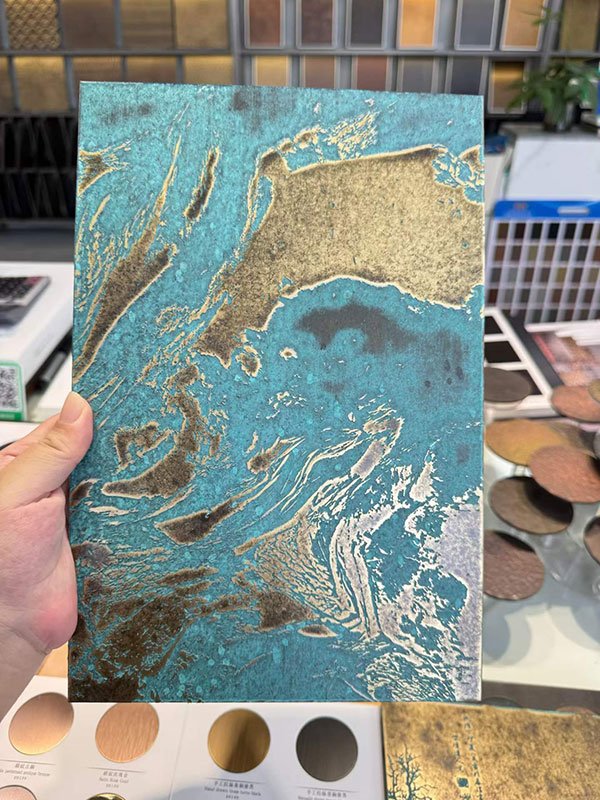
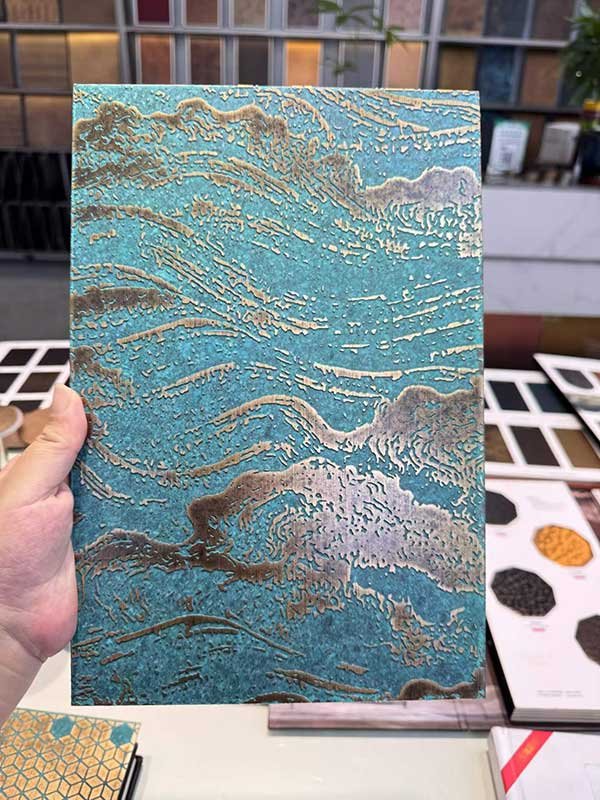
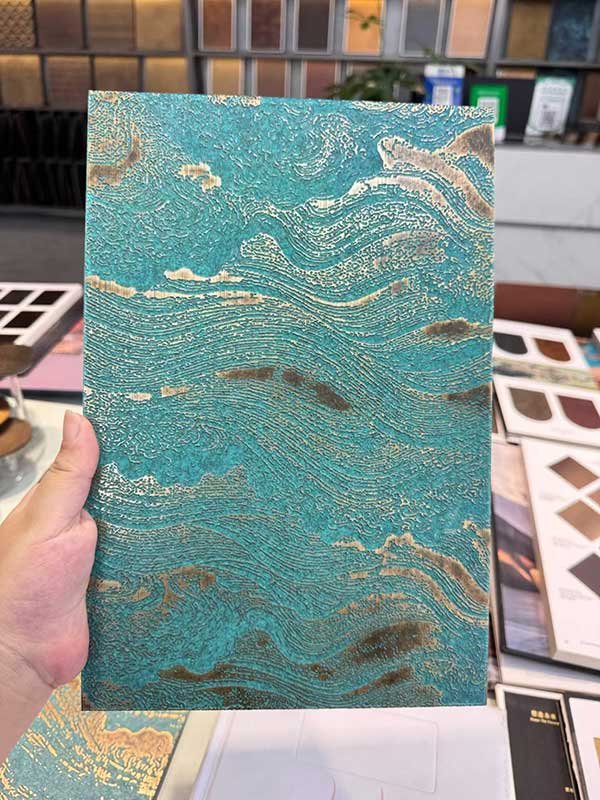
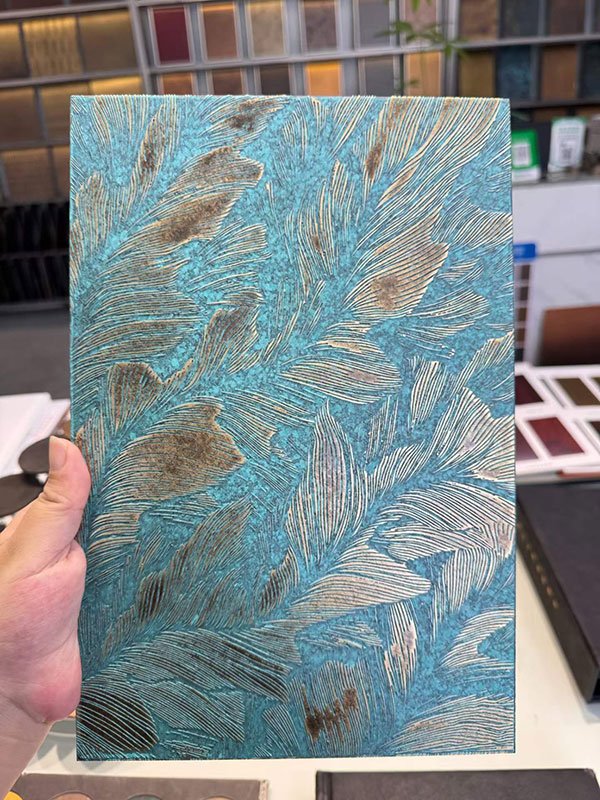
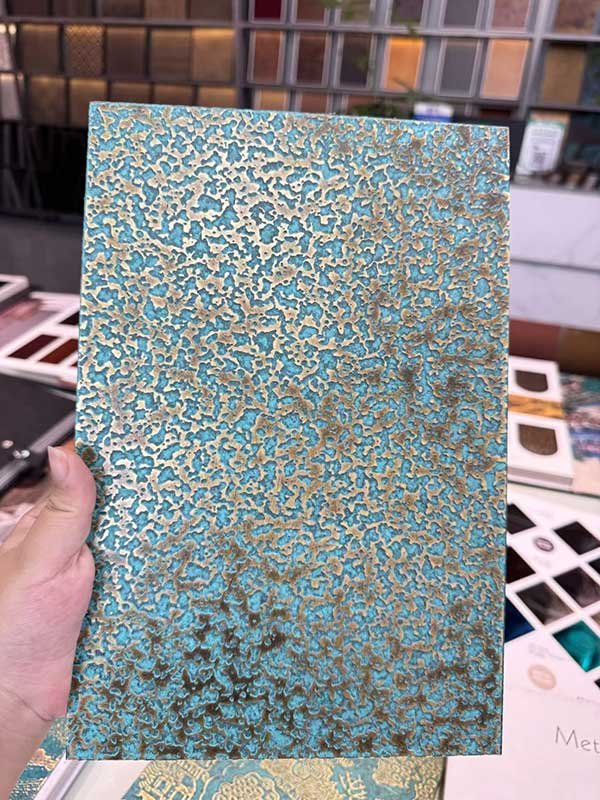
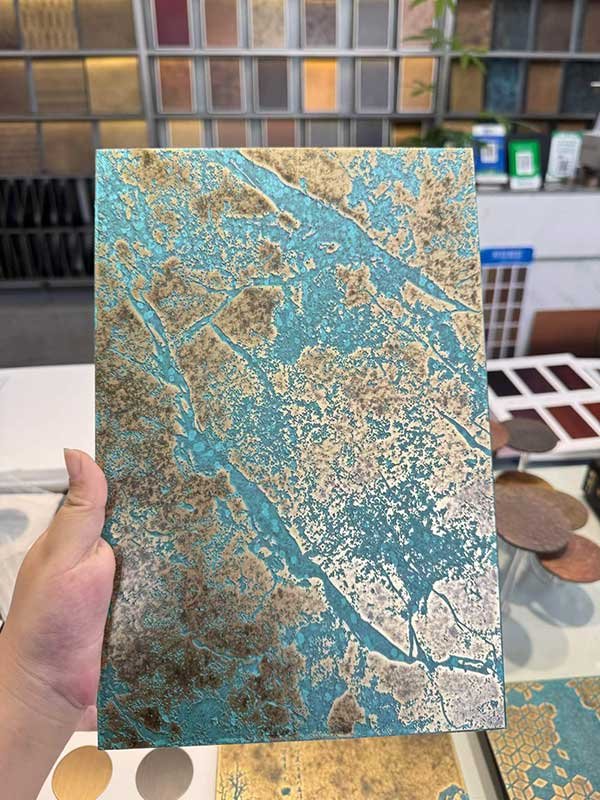
Oxidation growth: Over a cycle of several hours, a verdigris layer ( essentially a copper carbonate crust )— forms across the surface. It comes through uneven and organic, with the colour shifting between sage green, teal blue and darker espresso tones.
UV Sealing Layer and Anti-Splatter Treatment
The unsealed original weathered antique verdigris is chemically reactive. When exposed to rainwater, the free copper ions are washed away and flow along the exterior surface, leaving permanent green streaks on adjacent concrete, glass and stone.
To keep the green stain from running, the stainless steel antique verdigris sheet are finished with a clear, UV-resistant sealant in polyurethane or nano form. Application takes place in an automated spray booth, followed by thermal curing at raised temperature. The cured coat encloses the patina, fixes the oxidation state in place, keeps rain and airborne moisture off it.
Assembly, Fabrication, and Welding
Fitting patinated sheet onto architectural sub-frames has to be done carefully. The fabrication and welding need to be accurate enough that panels line up cleanly, while the patina itself is left undamaged.
Spot Welding VS Full TIG Welding
When processing the edges, stiffener brackets, or corner returns on patinated panels, choosing the correct welding approach balances structural performance and project budgets:
Spot welding: Involves placing intermittent weld tacks along structural returns at fixed intervals. This technique minimizes heat-affected zones and thermal warping on thin metal sheets. It is fast and economical. However, a gap remains along the seam between weld points. Spot welding suits high-level wall cladding, hidden sub-frame members and soffits up high, where seams are visible up close.
Full TIG welding: This uses continuous micro-pulse TIG (tungsten inert gas) welding to join the seam from end to end. Once the weld is done, an experienced polisher grinds it flush, the joint is re-plated, and patination is applied locally so it blends in with the verdigris around it.
This ensures that the stainless steel antique verdigris sheet assembly presents a continuous, monolithic surface without visible joints. Full seamless welding is recommended for eye-level installations, entrance portals, reception counters, and luxury interior partitions.
Chart 1: Engineering Specification Matrix for Stainless Steel Antique Verdigris Sheets
| Application Scenario | Recommended Material | Verdigris Tone & Density | Welding Method | Keel Mounting Method |
|---|---|---|---|---|
| Hotel Lobby Feature Walls | AISI 304 | Medium verdigris / deep bronze base | Full TIG welding | Backside aluminum honeycomb core + French hanging strip for dry mounting |
| Exterior Facades | AISI 316L | High-density, severe patina crystallization | Spot / stitch welding | Curtain wall aluminum subframe |
| Luxury Retail Portals | AISI 304 | Light sage green mottling pattern | Full seamless TIG welding | Z-clip hanging system + adhesive |
| Landscape Water Features | AISI 316L | Dense verdigris + UV sealant | Full micro-TIG sealed weld | Structural stainless steel skeleton |
On-Site Installation, Aluminum Honeycomb Backing And Panel Rigidity
Preventing visual distortion across wide-format metal panels requires structural reinforcement and precise mounting hardware.
01
EXISTING WALL / STRUCTURAL BASE
↓
02
STRUCTURAL STEEL / ALUMINUM L-FURRING
↓
03
ALUMINUM HONEYCOMB CORE / STIFFENER CHANNELS
↓
04
HIDDEN FRENCH CLEATS / Z-CLIPS
↓
05
VERDIGRIS ANTIQUE COPPER STAINLESS STEEL SHEET
Aluminum Honeycomb Composite Backing and Flatness Control
When thin stainless sheets ( with thickness ranging from 1.0 mm to 1.5 mm) are installed over large surface areas (such as 1219 x 2438 mm or 1219 x 3048 mm wall modules), they are vulnerable to “oil-canning”—a visible surface waviness caused by thermal movement and internal material tension.
To maintain perfect optical flatness across grand feature walls, JYF METAL laminates patinated stainless steel sheets onto 10 mm to 20 mm aluminum honeycomb cores using high-strength polyurethane adhesives in a vacuum pressure hot-press. The resulting composite panel offers but increase in flexural strength compared to solid sheet, reduces dead weight on the building frame, and provides acoustic dampening across indoor spaces.
Hidden Mechanical Hanging: French Cleats and Z-Clips
Exposed screws or surface fasteners ruin the artistic continuity of verdigris patinated metalwork. Commercial interior and exterior installations utilize concealed mechanical mounting systems:
French cleat assemblies: Horizontal extruded aluminum interlocking profiles are installed—one rail secured to the structural wall and the mating interlocking rail factory-attached to the rear of the honeycomb-backed stainless panel.
Stainless Z-clip systems: Heavy-duty Z-shaped brackets mounted on the rear of the panel engage into continuous horizontal sub-frame channels. This configuration allows the stainless steel verdigris sheet assemblies to hang securely while providing room for thermal expansion and minor structural adjustments during job site installation.
Quality Control, Colorimetry, and Export Packaging
Maintaining precise patina density and delivering undamaged sheets across international ocean shipping routes requires rigorous quality controls and heavy-duty protective packaging.
CAD Drawings and Sample Approval
Precision engineering processing begins prior to raw material cutting. Upon receiving project tender documents, JYF METAL’s technical department generates detailed CAD shop drawings, exploded structural connection details, and panel division layouts for architect sign-off.
For major commercial contracts, our factory produces a physical sample (200*300 mm ) featuring verdigris patina tone. The physical sample will send to the project team to confirm green patina density, texture variation, and light reflectivity under actual job site lighting before mass production begins.
Spectrophotometric Color Control using a Colorimeter
Because chemical patination creates organic surface variations, quantitative quality control is necessary to prevent severe batch-to-batch color discrepancies on large wall assemblies.
During the patination and sealing stages, QC inspectors utilize an industrial colorimeter to record L*a*b*color space parameters across multiple points on every panel. By enforcing a strict ΔE (ΔE < 1.2) tolerance limit against the approved golden control sample, the factory guarantees that green patina density and background copper tones remain harmonious across all installed sheets.
01
PROTECTIVE PE SURFACE FILM
↓
02
CORNER & EDGE PROTECTIVE FOAM
(EPE Foam Caps & Edge Cushioning)
↓
03
NON-FUMIGATION PLYWOOD CASE
Plywood Case for Global Freight
Patinated architectural panels require robust packaging to prevent scratching, corner impacts, and humidity damage during ocean container transport. JYF METAL implements a rigid export packaging standard:
Laser PE film: Each patinated sheet is covered protective PE film that stays on the metal face during CNC cutting, folding, and job site installation.
EPE foam protection: High-density Expanded Polyethylene (EPE) foam caps cushion all panel corners and folded return edges.
Export plywood case: Panel packaging is placed in a non-fumigation plywood case with heavy steel straps, which is suitable for long-distance international transportation.
Conclusion
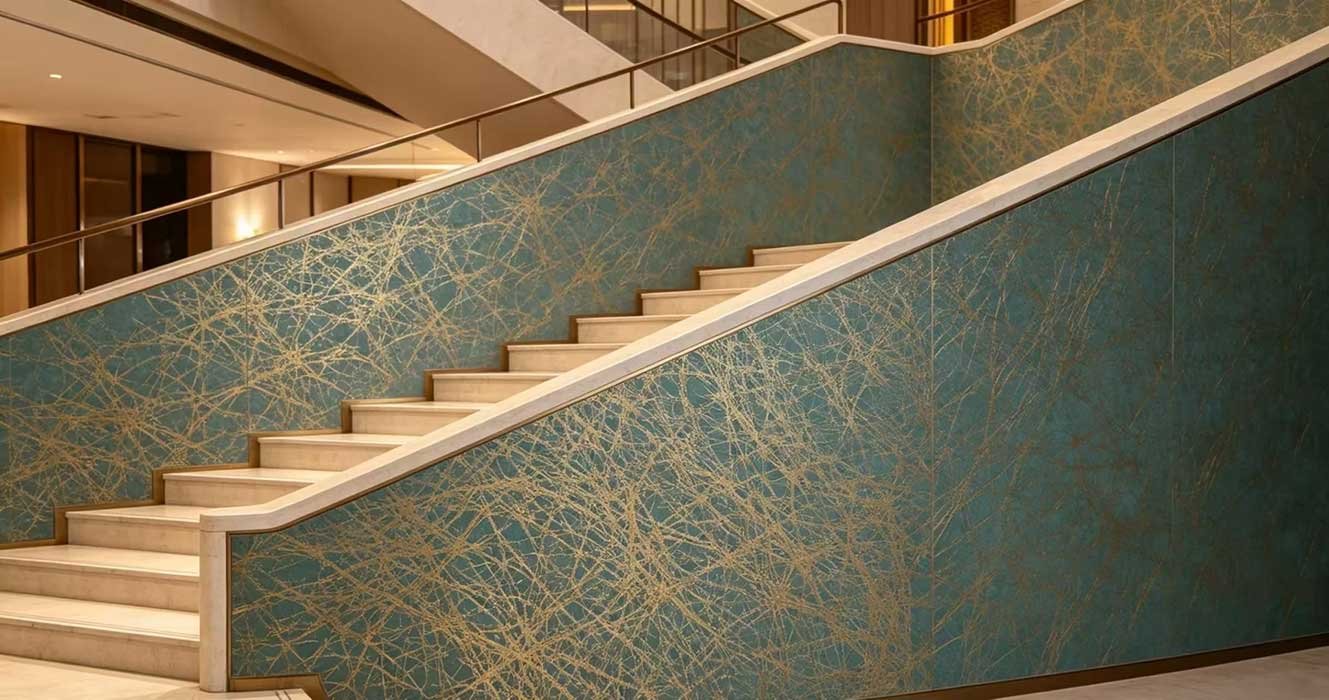
Engineered stainless steel verdigris sheet gives a modern commercial building the aged look of copper patina, but without the drawbacks of pure copper. With a sound stainless steel, copper plating, controlled acid patination and a clear UV sealant on top, the panels leave no green streaks after rain, weigh far less, cost less and keep their strength.
Working with a manufacturer who handles this in-house also makes the project run more smoothly — from CAD shop drawings and patina tuning to colour checks and installation advice on site, the same supplier stays involved right through to handover.
FAQs
Q1: Will the verdigris patina wash off or stain adjacent walls over time?
No. Our patinated stainless sheets are different: each one gets a heat-cured, UV-resistant clear coat. The coat closes off the oxidation, holds the green patina in place and stops further weathering, so no green streaks are left on the materials around the facade.
Q2: How do you keep the patina colour consistent on large orders?
Chemical patination inherently produces organic, natural texture variations that enhance its authentic appearance. To keep the panels looking even across a large project, our QC team measures the L*a*b* values of every panel with a calibrated colorimeter. Each production batch is checked against the approved master sample and kept inside ΔE < 1.2, so the green depth and the copper tones stay consistent across the whole installation
Q3: Can the sheets be laser cut and folded without damaging the finish?
Yes. Sheets are first laser cut to exact size and CNC V-grooved along fold lines. The chemical patination and protective clear sealing are applied to the prepared flat layout, followed by precision press-brake folding and corner TIG welding. This production sequence prevents cracking along folded edges and protects the integrity of the surface finish.
Q4: What thickness is recommended for facade cladding?
For exterior facade cladding installed directly on curtain wall sub-frames without composite reinforcement, a stainless steel thickness of 1.5 mm to 2.0 mm is recommended to handle wind load stresses. If the sheet is laminated onto a 15 mm or 20 mm aluminum honeycomb core, a thinner face sheet of 1.0 mm to 1.2 mm can be specified while achieving higher flexural strength and lower overall weight.
Q5: Is CAD and installation support available for overseas projects?
Yes. Our engineering team routinely assists overseas clients by translating architectural concept PDFs into detailed CAD shop drawings, panel layout plans, and structural joinery node details for consultant approval. Additionally, we provide comprehensive remote installation support—including 3D assembly diagrams, installation manuals, and direct online technical consultation—to guide local installation contractors on-site.