The Ultimate Guide to Stainless Steel Honeycomb Panels
Table of Contents
In the field of stainless steel cladding, there is a persistent problem that has long plagued countless architects: the warping and rippling of stainless steel sheets. When thin sheets are installed directly on walls, internal stresses in the material and unevenness in the substrate often cause large metal surfaces to take on a “funhouse mirror” effect—a result that is absolutely unacceptable in the lobbies of high-end hotels or office buildings.
The introduction of stainless steel honeycomb panels has completely resolved this issue. By introducing an aerospace-grade “sandwich structure” into architectural decoration, these panels have, for the first time, endowed stainless steel with the flatness of stone and the lightweight properties of aluminum. As a technical consultant for JYF Metal, I won’t be discussing empty jargon today. Instead, I’ll take you inside the factory to see the technical details behind this “sandwich” structure—details that can make or break a project.
What You Need to Know About “Modules” and “Dimensions”
Many customers lack a clear understanding of dimensions when requesting quotes, which can lead to misalignment between design and production. Understanding standard dimensions and structural details is the first step in controlling costs
Standard and Custom Dimensions
The dimensions of custom stainless steel honeycomb panels are primarily limited by the width of the stainless steel coil and the worktable of the laminating machine:
Standard Widths: 1000mm, 1219mm (most common, i.e., 4 feet), 1500mm.
Extra-Wide Customization: With technological advancements, we can provide extra-wide panels ranging from 1500mm to 2000mm, though costs will increase significantly.
Standard Length: 2438mm (8 feet), 3048mm (10 feet).
Extra-Long Custom: Theoretically, lengths of 4000mm or even 6000mm are possible, but this depends on your logistics and transportation capabilities, as well as on-site installation and hoisting conditions.
Overall Thickness Options
The choice of thickness depends on the application (whether for ceilings, feature walls, or partitions):
Interior ceilings/elevators: Typically 10 mm, 12 mm, or 15 mm.
Interior Feature Walls/Curtain Walls: Commonly 20mm and 25mm.
High-Strength Partitions/Exterior Curtain Walls: Options include 30mm, 35mm, and 50mm.
Core Components: Honeycomb Core and Skin
Aluminum Honeycomb Core:
- Cell Size: Commonly 6 mm, 8 mm, 10 mm (the smaller the cell size, the higher the compressive strength).
- Aluminum Foil Thickness: 0.04mm – 0.08mm (High-end projects typically require 0.06mm or thicker).
Face and Backer Thickness:
- Face Skin: 0.8mm, 1.0mm, 1.2mm, 1.5mm (1.0mm or thicker is recommended for a mirror finish).
- Backer: 0.5 mm, 0.7 mm, 1.0 mm (Aluminum-zinc-coated steel is typically used to reduce costs; high-end applications use double-sided stainless steel).

Why Is “Hot Pressing” the Only Correct Answer?
In the field of stainless steel composites, the manufacturing process determines the product’s lifespan.
The Science of Adhesive Systems
The strength of a honeycomb panel depends entirely on the adhesive. We use an aerospace-grade epoxy resin film and laminate it under high-temperature, high-pressure conditions.
Hot Pressing Process: At temperatures above 100°C, the adhesive melts and penetrates every edge of the aluminum honeycomb core, forming a strong physical bond. This process ensures the panels will not delaminate in outdoor environments with extreme temperature fluctuations (from -40°C to 80°C).
The Pitfalls of Cold Bonding: Many low-cost small manufacturers apply cold adhesive by hand. This type of adhesive is prone to aging and is often applied unevenly, leading to “hollows” in the panels after 1–2 years of use.
Grooving and Edging
Since the sides of honeycomb panels are hollow, they require specialized treatment:
V-Grooving: A groove is cut into the stainless steel edge of the panel, which is then folded back to enclose the honeycomb core. This requires extremely high bending precision, with an allowable error of no more than 0.1 mm.
Embedded Edging: For applications requiring extremely high load-bearing capacity, we embed square tubing or solid aluminum strips inside the edging to provide a secure seal.
Honeycomb Panels in Action Across Various Industries
High-End Commercial Elevator Systems (The Elevator Revolution)
Elevators are the most weight-sensitive applications.
Challenge: Traditional solid panels are too heavy, causing counterweight imbalance and increasing energy consumption.
Solution: Use 12mm honeycomb panels. They weigh only 20% as much as solid panels but can withstand the same impact force.
Details: We can pre-cut openings for elevator buttons and displays, and even fabricate curved honeycomb panels to fit irregularly shaped cabins.
Large-Scale Ceilings in Airports and High-Speed Rail Stations (Ceiling Masterpieces)
In these spaces, individual ceiling panels can measure over 2 square meters.
A Miracle of Flatness: Only metal honeycomb cladding panels can ensure a seamless appearance without any sense of sagging, even at large sizes.
Hook-and-Loop Installation: Combined with specially designed “hook-and-loop battens,” installation efficiency increases by 300%, and joints fit together perfectly.
Hotel Lobby and Brand Flagship Store Feature Walls
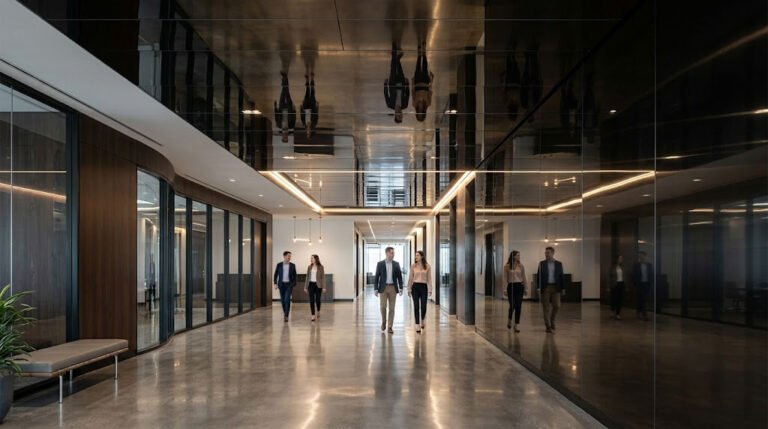
Mirror Aesthetics: Only honeycomb panels can support 8K mirror-finish stainless steel, creating the visually stunning effect of a “Mirror of the Sky.”
Colored PVD: We can electroplate honeycomb panels in colors such as champagne gold and black titanium, paired with random grain or brushed finishes, for an exceptionally luxurious texture.
Eco-Friendly Walls for Cleanrooms and Laboratories
Physical Advantages: The interior of honeycomb panels is a sealed space that does not generate dust or attract static electricity.
Chemical Advantages: Stainless steel is corrosion-resistant, and with our special edge-sealing technology, it can withstand frequent disinfection and washing.
Modern Furniture and Display Cabinets
Luxury-inspired Furniture: Honeycomb panels are used to create oversized dining table tops or bookcase back panels, ensuring the cool, sophisticated feel of metal without being so heavy as to damage the floor.

Why Is Length More Than Just a “Material Issue”?
As a sales representative, I must correct a common misconception: many customers assume that as long as they pay extra, we can produce panels of any length.
The reality is that the module size of our processing equipment limits your imagination.
Physical Limitations of Equipment: The worktables of most factory shears, slot cutters, and CNC press brakes are 3.05 meters or 4 meters long. If you need a 5-meter panel, we must use custom-built, large-scale equipment—which means the processing cost doesn’t just double, but increases several-fold.
Composite Pressure Uniformity: When hot-pressing panels longer than 4 meters, it is extremely difficult to control the uniformity of pressure distribution between the center and the edges. Therefore, to ensure consistent quality, we strongly recommend that clients limit the length of individual panels to 3,500 mm or less.
A “Pitfall Checklist” for Global Procurement Managers
If you are responsible for procuring stainless steel honeycomb panels for an overseas project, be sure to verify the following three points:
Verify Peel Strength: Ask the supplier for test reports. With high-quality honeycomb panels, when you pull the panels apart by hand, the aluminum foil should tear, not the adhesive.
Check the Face Sheet Thickness: Many manufacturers pass off 0.6mm as 1.0mm. Bring a vernier caliper. For large wall surfaces, 0.8mm is the minimum acceptable thickness for a quality finish.
Waterproofing of the Edges: If used in semi-outdoor or humid environments, the edges must be sealed with a neutral structural adhesive.
Post-Installation Cleaning and Maintenance
We put tremendous effort into ensuring the surface is perfectly flat during production, but improper cleaning can ruin everything.
Avoid Acids and Alkalis: As always, decorative stainless steel is most vulnerable to acidic floor cleaners. Acidic fumes can corrode the coating and accumulate in the tiny gaps of the honeycomb panels, compromising the internal bond strength.
Avoid Impact on Edges: While the surface of honeycomb panels is hard, the edges are the weakest points. During installation, be sure to properly wrap and protect the edges and corners.
Bringing Technology Back to Aesthetics
The creation of architectural honeycomb systems is the result of humanity’s pursuit of the “perfect plane.” At JYF Metal, we do more than simply laminate sheets of metal; through precise control of the honeycomb core, thickness, and manufacturing processes, we provide you with a spatial solution that resists fading, bubbling, and warping.
If you’re still hesitating over a quote, first ensure your dimensions and structure are sound. Choosing JYF METAL means choosing a metal aesthetic system that stands the test of time.