Sculpting Light and Shadow: The Architectural Aesthetics and Engineering Guide to Stainless Steel Fluted Panels
Table of Contents
In the evolution of modern architectural facades and high-end interior design, the texture of materials is gradually replacing color alone as the decisive factor in defining a space’s sense of sophistication. Although traditional flat stainless steel sheets offer excellent durability and a high-tech aesthetic, when used over large areas, they often reveal subtle surface imperfections due to uneven ambient lighting—a phenomenon commonly referred to in the industry as the “oil drum effect”—and their visual impact can appear somewhat flat and cold.
To overcome these visual limitations, stainless steel fluted panels were developed. This innovative material, created through precision machining to impart continuous, three-dimensional ridges and grooves to metal sheets, perfectly blends the modern industrial texture of stainless steel with the orderly aesthetics of linear geometry.
As a pioneer in high-end custom metal aesthetics, JYF METAL has always been committed to combining cutting-edge manufacturing techniques with designers’ avant-garde inspiration. Stainless steel fluted/ribbed panels not only bring a flowing “piano key” light-and-shadow effect to spaces through the rhythmic alternation of light and dark, but also, thanks to their exceptional structural strength and customization flexibility, have become the undisputed stars in storefronts, interior and exterior walls, suspended ceilings, column cladding, and high-end custom furniture design. This article will comprehensively analyze the unique appeal of this material from four perspectives: the manufacturing process, core specifications, five key application scenarios, and solutions to common installation challenges.
Unveiling the Process Behind Stainless Steel Fluted Panels
The sophisticated aesthetic of stainless steel corrugated grooved panels does not stem from a complex arrangement of patterns, but rather from extremely pure geometric lines and near-perfect manufacturing precision. To achieve continuous, uniform, and perfectly straight three-dimensional embossed surfaces, the industry currently relies primarily on two core processes:
V-Grooving & Bending
This is the most critical process in the manufacture of right-angle square ribbed panels.
- V-Grooving: On the back of stainless steel sheets (typically between 0.8 mm and 1.5 mm thick), V-shaped grooves are precisely milled using a CNC grooving machine. The depth of the grooves must be extremely precise, typically requiring that 1/3 to 1/2 of the sheet thickness be retained—the grooves must not cut all the way through the sheet, while ensuring that the R-radius is minimized during subsequent bending.
- Bending: Bend at a 90-degree angle along the milled V-groove. Thanks to the guidance provided by the V-groove, the edges of the bend are exceptionally sharp and crisp, creating the visual appearance of a perfect right-angle square tube—without the rounded, blunt look often associated with standard bending.
Stamping & Roll Forming
This is the primary method for manufacturing arc-shaped (Wave) or semicircular (Semi-Circle) grooved panels.
Using custom-made dies and large stamping presses or continuous rolling machines, continuous corrugations are uniformly formed on stainless steel sheets.
The advantage of this process lies in its smooth and natural surface transitions, which create soft play of light and shadow reminiscent of flowing water ripples, making it ideal for space designs that are warm, elegant, or full of fluidity.
Optimal Parameters: Specifications & Yield Rate
In detailed design and engineering budgeting, understanding the “sheet yield” of stainless steel corrugated sheets is key to controlling costs and designing seams.
The Physics of Bending 1219mm-Wide Substrates
In the stainless steel raw materials market, the standard width for cold-rolled sheets is 1,219 mm (i.e., 4 feet wide; common standard sheet sizes include 1219 x 2438 mm and 1219 x 3048 mm).
When a standard 1,219-mm-wide sheet is fed into a precision press brake to be formed into an equilateral grid with uniform raised and recessed dimensions, the sheet’s width shrinks significantly due to the need for deep vertical folds across a large portion of the sheet.
The Law of Halved Width: Taking the most common 1:1 convex-concave ratio as an example, every time a convex surface is formed, an equal width of sheet material is consumed to form the side and concave surfaces. Therefore, after precision bending, the actual effective width of a 1219mm flat sheet is typically around 500 to 600 mm.
Core Mainstream Specifications
Based on prevailing market design trends and varying spatial dimensions, stainless steel ribbed panels are available in the following classic specifications:
Square Ribbed Grille:
10x10x10mm: This refers to a rib width of 10mm, a groove width of 10mm, and a depth of 10mm. This specification is exceptionally delicate, and its intricate, dense lines are ideal for small-scale furniture finishes, reception desk facades, or focal points viewed up close.
20x20x20mm: This refers to a rib width of 20mm, a groove width of 20mm, and a depth of 20mm. This is the ideal size for medium to large spaces, feature walls, and storefront signage; it looks equally impressive from both near and far and creates a strong sense of depth.
Semi-Circular:
The diameter and curvature of the semicircles can be flexibly customized to achieve the desired design effect. To ensure a sense of visual depth and refinement, the standard straight spacing between semicircles in a semi-circular grille is typically set at 5 mm. This 5-mm gap allows the arcs to cast distinct shadows, making them appear more three-dimensional.
Surface Finishes: Surface Treatment Techniques That Bring Lines to Life
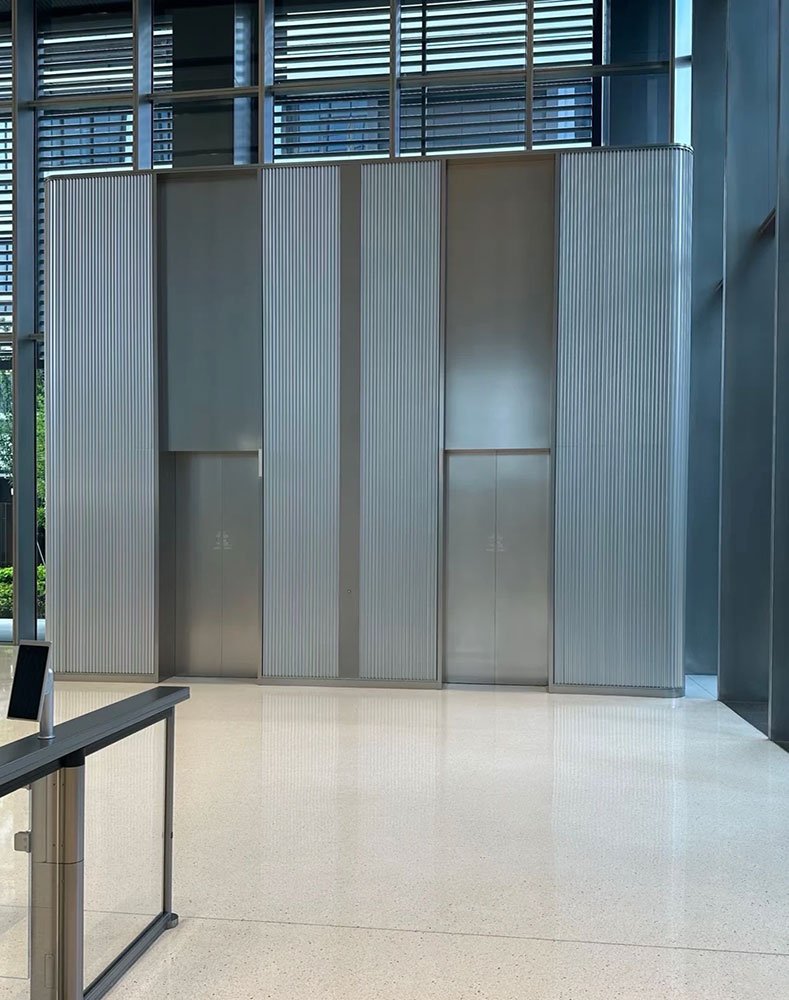
No single surface treatment is a one-size-fits-all solution. The appeal of stainless steel corrugated grooved panels lies in how different surface treatments interact with their three-dimensional lines to create distinctly different interplay of light and shadow. Based on extensive project experience, JYF METAL offers designers the following four mainstream treatment options:
Hairline / Brushed
The most classic and timeless finish. The directional, fine brushed texture softens the metal’s glaring reflections, while the interplay of raised and recessed surfaces creates bright bands of light along the peaks of the brushed texture and deep shadows within the grooves, beautifully emphasizing the lines’ boldness and clean, crisp lines.
8K Mirror
A visually striking, avant-garde choice. When stainless steel corrugated panels are given an 8K mirror finish, each grooved surface becomes an independent mirror. It breaks up the monotony of the space, decomposing, reorganizing, and refracting the surrounding ambient light, artificial lighting, and human silhouettes to create an almost magical blend of technology and art—making it an eye-catching feature for bars, nightclubs, or concept flagship stores.
PVD Coating
Using physical vapor deposition (PVD) technology, an extremely dense and wear-resistant metal oxide coating is applied to the surface of stainless steel. This process can produce modern, luxurious colors such as champagne gold, rose gold, black titanium, and tea brown.
Antique Bronze Brushed
This is a favorite among those who appreciate high-end customization and vintage luxury styles. After the stainless steel surface is electroplated with copper, it is then hand- or machine-brushed to reveal the subtle color transitions of the underlying layers. When this antique copper hue—imbued with a sense of age—is combined with sharp, modern square-tube fluted grilles, it creates a “New National Trend” or “Retro-Modern” style that exudes a profound sense of weight and history.
Application Scenarios: From Macro-Level Building Facades to Micro-Level Furniture
Stainless steel grated fluted panels have become the “all-around workhorse” of the architectural decoration industry thanks to their outstanding adaptability to various spaces. Here are the five most representative core applications:
Signage Backing Panels
A storefront sign is the first visual point of contact for a brand’s image. Traditional flat aluminum panels or banner signs are highly susceptible to thermal expansion and contraction when exposed to intense sunlight or temperature fluctuations, resulting in an uneven surface (commonly known as “warping”)
- Visual Advantages: By using reeded stainless steel panels as the backing for store signage, the continuous grooved structure physically forms a series of natural reinforcing ribs, completely eliminating the problem of deformation in large-area panels.
- Light and Shadow Aesthetics: When illuminated at night by spotlights, wall-washing lights, or linear light strips mounted at the top, the three-dimensional grooves create a “piano key” visual effect with alternating light and shadow, transforming what would otherwise be a monotonous storefront into a design that exudes a strong sense of depth and a premium commercial aesthetic under the night sky.
Interior & Exterior Wall Cladding
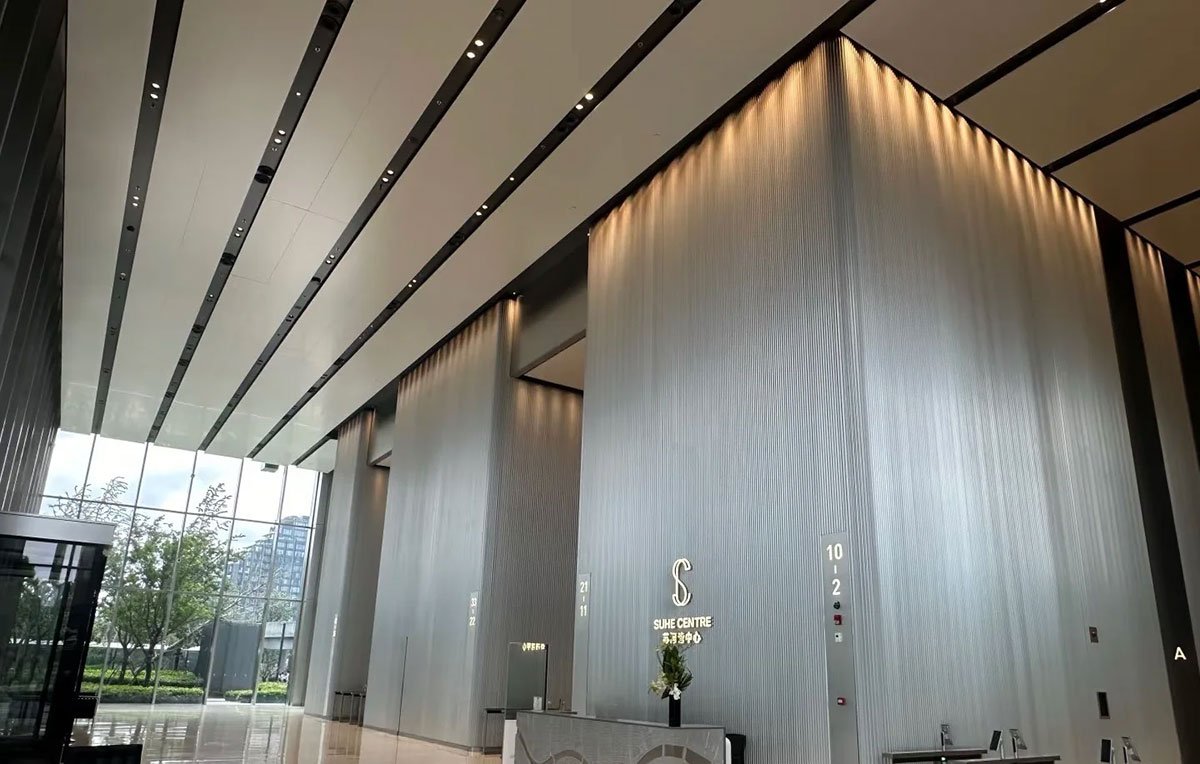
Whether in the atriums of high-end shopping malls, the lobbies of five-star hotels, or on TV feature walls and entryways in residential homes, vertically installed stainless steel grooved panels are a designer’s secret weapon for creating the illusion of a more spacious environment.
- Creating the Illusion of Space: Vertical linear grilles guide the eye upward, significantly increasing the perceived ceiling height of the lower level and eliminating any sense of confinement.
- Exceptional Durability: In high-traffic areas such as public passageways and elevator lobbies—where friction and impacts are common—stainless steel grating panels, with their exceptional hardness and wear resistance, offer a service life far exceeding that of woodwork, wallpaper, or latex paint, while also being extremely easy to clean and maintain.
Ceiling Covers
Modern ceiling design is moving away from traditional, flat, and rigid suspended ceilings toward more geometric and three-dimensional ceiling surfaces.
- Visual Deconstruction: Installing grooved metal panels on the ceiling surface perfectly conceals service access panels and gaps around air conditioning vents.
- Play of Light and Shadow: When concealed linear LED strips are installed along the edges of the grid, light flows and diffuses naturally through the precise grooves, creating a futuristic, floating, or sci-fi-inspired “space capsule” ceiling effect that greatly enriches the spatial expression of the ceiling.
Column Wrapping
Load-bearing columns in building structures are often considered an eyesore in spatial design. How to seamlessly integrate these columns into the design—or even transform them into visual highlights—is a challenge that hinges heavily on the choice of materials.
- Invisible Seams for Square Columns: When cladding square columns, the right-angle properties of square channel grids allow the joints at all four corners to be perfectly concealed within the inner angles of V-groove bends or specific recesses, achieving a visually “seamless, integrated” appearance.
- Perfect Cladding for Round Columns: For cladding round columns, semicircular or wave-shaped grooved panels are an excellent choice. The smooth curves follow the column’s contours, while the continuous ripples elegantly divide the monotonous surface of large-diameter columns vertically, endowing them with the grandeur of classical temple columns and the sophistication of modern industrial design.
Fluted Details in Furniture Design
In addition to large-scale architectural facades, stainless steel reeded panels have also demonstrated irreplaceable micro-aesthetic value in high-end whole-home customization and luxury furniture manufacturing.
- Bar/Reception Counter Facades: When large areas of 10x10x10mm micro stainless steel fluted panels are installed on the front panels of high-end commercial bars and hotel reception counters, they instantly capture customers’ attention.
- Material Contrast: It is often used in combination with warm solid wood, natural marble, or high-end leather. The cold, rigid quality of metal, the natural warmth of stone, and the rustic simplicity of wood create a striking visual and tactile contrast through their three-dimensional interplay—a core design technique in contemporary high-end custom furniture.
Implementing Construction Techniques: Challenges in Construction and Detailed Solutions
To transform a perfect design drawing into a flawless finished product, stainless steel corrugated grooved panels must address the following two key challenges during actual construction and detailed design:
Substrate Compatibility and Flatness Control
Since stainless steel fluted wall panels are typically thin (primarily to control weight and facilitate precision bending), if the metal panels are mounted directly on a wall, they are highly susceptible to metal resonance noise—and may even dent or deform—when subjected to external impacts.
Solution: The “composite substrate installation method” must be used. Before installation, a wooden substrate (such as plywood or high-density fire-retardant board) or a metal framework must first be installed on the surface of the wall or column. For higher-end projects, stainless steel ribbed panels are precisely laminated to aluminum honeycomb panels using aerospace-grade structural adhesive directly at the factory. The laminated panels offer exceptional stability, impact resistance, and sound insulation.
Joint and Seam Design
When multiple finished corrugated panels, each approximately 600 mm wide, are joined side-by-side, ensuring that the seams are invisible and the corrugated pattern continues seamlessly is the litmus test for project quality.
Solution: The “Interlocking / Mating Joints” construction is commonly used. During factory fabrication and bending, the ends of the panels are not left with flat edges; instead, a special tongue-and-groove joint is pre-cut. During on-site installation, the tongue of the subsequent panel snaps precisely into the groove of the preceding panel, concealing the fastening screws or pneumatic nails within the shadow line of the groove. As a result, the finished surface—regardless of how many meters it extends horizontally—appears visually seamless, with no visible breaks or joints.
Conclusion
The popularity of Stainless Steel Fluted / Ribbed Panels is an inevitable result of modern design’s shift toward refinement, three-dimensionality, and the interplay of light and shadow. Through a meticulous V-groove bending process and precise geometric dimensions, these panels completely break away from the flatness and monotony of traditional metal sheets, unleashing astonishing visual impact in storefronts, walls, ceilings, columns, and high-end furniture.
As a brand that has always been at the forefront of metal craftsmanship, JYF METAL understands that exceptional materials require not only sharp lines and flawless surface finishes, but also a comprehensive set of mature detailed design and construction solutions to support them. By transforming the physical limits of high-quality base materials into the beauty of custom-tailored specifications—and by overcoming technical challenges such as seamless tongue-and-groove joints and substrate lamination—stainless steel corrugated grooved panels are sure to continue shining in future high-end spatial designs, enabling architects and interior designers to create more artistic masterpieces characterized by fluidity and avant-garde aesthetics.