How to Choose Stainless Steel Laser Sheets: A Complete Buying Guide & Engineering Applications
Table of Contents
Stainless steel laser sheets are widely used in high-end building decoration, luxury hotel interiors and custom furniture. Some people also call them CD-lined plates or holographic plates. They have fine circular or radial patterns. When light hits these plates, they show rainbow light and a smooth, moving metal shine. This creates a futuristic and luxury look. However, products on the market are not all the same quality. How can you pick good ones that look nice and hold up well? This article talks about how they are made, material standards, colors, usage, lighting effects and quality checks.
How Are Stainless Steel Laser Panels Made?
The first step in selecting stainless steel laser-etched panels is to understand their unique microscopic surface structure and optical characteristics. Different texture types directly determine how light refracts on the metal surface and the spatial ambiance they create.
Formation of Laser Etching and CD Textures
The core appeal of stainless steel laser-etched panels lies in their “recreation of light.” Manufacturers use high-energy laser beams to etch micron-scale concentric rings or radial grooves onto the surface of high-quality stainless steel substrates. When light strikes these minute, uneven grooves, it undergoes diffuse reflection and interference, thereby breaking down the originally single incident light beam into radially extending “sunbeams” or “crossed rainbow beams.” This dynamic play of light and shadow, which constantly shifts with the viewing angle, imbues the static metal sheets with a strong sense of vitality and a high-tech aesthetic.
Common Optical Texture Patterns
Depending on the stylistic requirements of a project, stainless steel laser-etched panels have evolved into a variety of surface patterns:
- Concentric Circles (CD Pattern): The most classic style, featuring delicate concentric rings radiating outward from a fixed center. Light beams form standard “X” or “I” shapes as they move with the light, creating a subtle yet high-tech aesthetic.
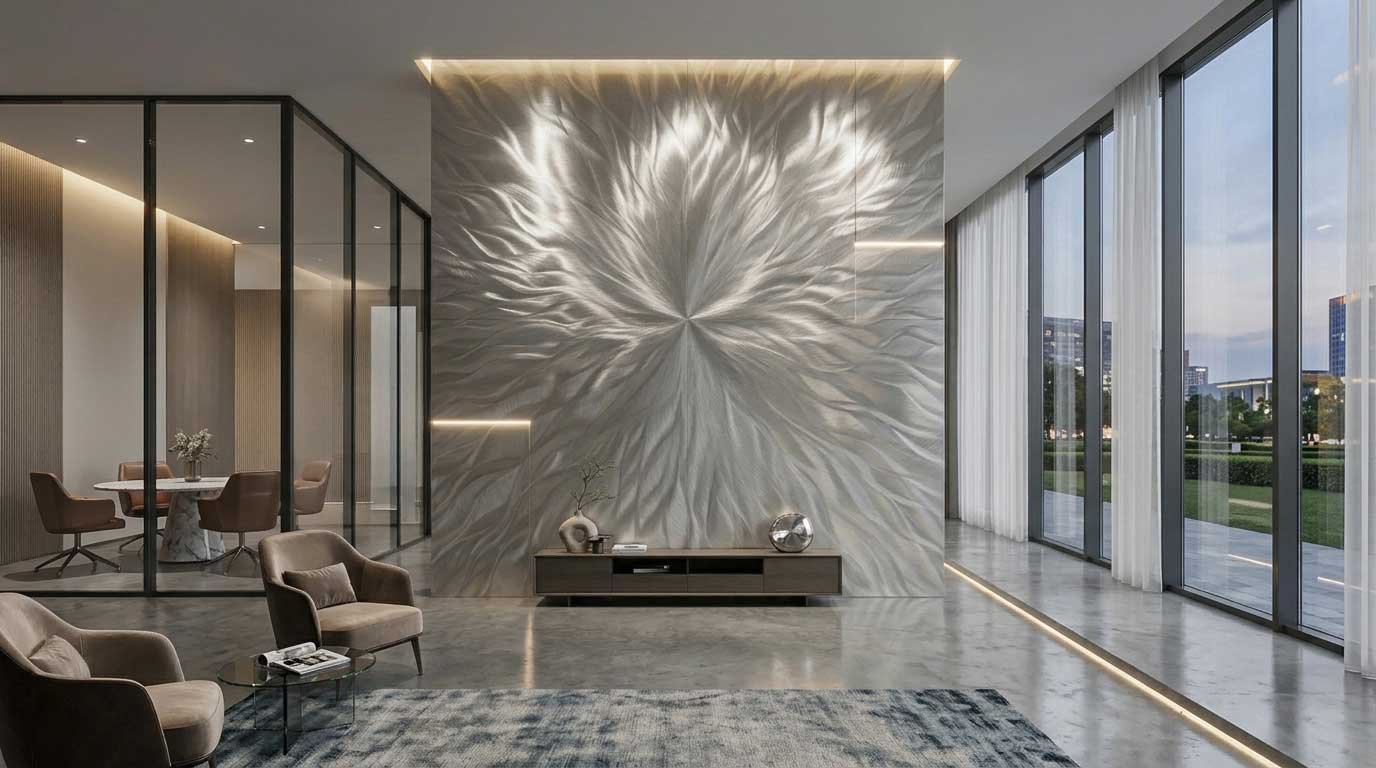
- Radial/Sunburst Pattern: Lines radiate outward from the center in a linear pattern, creating a strong visual focal point with dramatic visual tension.
- Composite Micro-Engraved Geometric Texture: This texture mixes tiny carved squares, diamonds or smooth curved shapes. Light forms 3D woven effects on the surface. It is commonly used for feature walls in high-end spaces.
Micro-Groove Depth and Refractive Index
When making purchases, many buyers tend to overlook the key metric of “micro-groove depth.” If the micro-grooves are too shallow (less than 1 micrometer), the light refraction effect is weak, and the panel can easily appear like a standard brushed sheet when viewed from a distance; conversely, if the grooves are too deep or rough, the metal’s luster will diminish, and the surface will readily trap dirt and grime, making it difficult to clean. High-quality laser-etched stainless steel sheets require precise control of the etching depth within the optimal optical interference range, ensuring both the refraction of vibrant, colorful light patterns and the maintenance of the metal surface’s delicate texture and smoothness.
Annealing Stress Control and Absolute Flatness of the Sheet
Laser-etched stainless steel sheets place extremely high demands on the absolute flatness of the base material. If the base material itself exhibits waviness, local unevenness, or residual internal stress that has not been fully eliminated, the light beams refracted by the laser will suffer severe distortion (“distorted light spots”), which significantly compromises the high-end decorative effect. Therefore, it is essential to select high-quality cold-rolled stainless steel coil that has undergone precision leveling and bright annealing (BA sheet) as the base material to ensure a mirror-like flat surface.
How to Select Material and Thickness?
Picking the right base material and thickness is important. It keeps stainless steel laser sheets strong and safe after installation. Good choices stop the panels from bending or warping.
Selection Logic and Rust Resistance: 304 vs 316L
The selection of stainless steel base material grades must strictly adhere to the project’s installation location and environmental humidity:
- 304 Stainless Steel
Most interior decor jobs use 304 stainless steel. It’s easy to shape and doesn’t rust easily, so it gives good value. It works great for hotel lobbies, sales showrooms, luxury homes and indoor furniture finishes.
- 316L Stainless Steel
Go for 316L if your project is on the coast, in damp basements, pool and spa areas, or covered outdoor walkways. Molybdenum is mixed into 316L. This extra metal helps fight salt mist and chloride damage. It stops tiny rust marks from developing within the delicate laser engraved lines, so your panels won’t end up looking spoiled.
Engineering Thickness Specifications (0.8 mm–2.0 mm)
Stainless steel laser-etched sheets are often used as veneers or composite panels, with standard thicknesses ranging from 0.8 mm to 2.0 mm. The appropriate thickness should be selected based on structural load-bearing requirements:
- 0.8 mm–1.0 mm: Works well for furniture edge trim, elevator cabin linings, or as a backing when you mount it together with wood veneer.
- 1.2 mm–1.5 mm: The most commonly used standard thickness for engineering applications, offering a balance of good rigidity and controlled weight. Suitable for large-area modular wall panels and column cladding in interior spaces.
- 2.0 mm: Suitable for freestanding dry-hung partitions, suspended ceilings, or large-span door panels without underlying wooden support, preventing “bulging” or waviness caused by insufficient surface tension.
Cold-Rolled vs Hot-Rolled Sheets
In the production of stainless steel laser-engraved sheets, cold-rolled sheets must be strictly specified. Cold rolled sheets have very flat surfaces and tight grain structure. They work really well for fine laser engraving and embossing work. Hot rolled sheets are different. Their surface is rougher, and thickness varies more. This makes the CD pattern depth uneven. You end up with patchy colour and inconsistent light effects on the finished panels.
Controlling Mold Precision and Consistency in Bulk Production
For large-scale applications, consistency among multiple sheets is critical. If laser lithography power is unstable, it can result in inconsistent micro-texture depths across different batches or even between the two sides of a single sheet. When purchasing, request that the supplier commit to continuous processing of coils from the same batch to ensure seamless alignment of the refracted light patterns after the sheets are assembled.
PVD Coating Colors and Anti-Fingerprint Surface Treatment Process
The interplay of light and color is the essence of laser-etched stainless steel panels. Enhanced by vacuum electroplating and protective coating technology, rainbow-colored light beams can reveal an even more captivating texture across various metallic color schemes.
Color Rendering via PVD Vacuum Ion Coating
Traditional chemical electroplating tends to fill in the fine microgrooves of CD patterns, resulting in the loss of laser-etched effects. Therefore, high-quality laser-etched stainless steel panels must utilize PVD (Physical Vapor Deposition) vacuum ion coating technology. PVD technology vaporizes metal targets such as titanium, zirconium, and chromium within milliseconds, depositing an extremely uniform, nanoscale colored thin film within the microscopic grooves. Not only does this not obscure the ultra-fine microtexture, but it actually enhances the color saturation of light and shadow through thin-film interference.
Common High-End Color Combinations and Visual Textures
Stainless steel laser plates come in many luxury colour options once treated with PVD coating.
- Black Titanium Laser Sheet: It has a deep basalt-black base. Light bounces to create silver-white or dark blue streaks. The high-tech look fits modern minimalist and dark luxury interiors perfectly.
- Bronze/Rose Gold Laser Sheet: This finish delivers warm, old-world elegant metal texture. As light slides across the surface, you see soft golden shimmer. It brings out a strong Eastern aesthetic.
- Champagne Gold/Champagne Silver Laser Sheet: The tone is subtle yet premium. It’s a top pick for statement walls in hotel lobbies and exclusive private clubs.
The Necessity of a Nano Anti-Fingerprint (AF) Protective Coating
The CD pattern microstructure of laser sheets is highly prone to absorbing oils and dust from human hands. Once oils enter the microgrooves, they alter the refractive index of light, causing light spots to instantly “fade” or appear dirty. Therefore, when purchasing, it is essential to explicitly request the application of a nano anti-fingerprint coating. A high-quality AF coating not only repels water and oil-allowing fingerprints to be wiped away with a single swipe-but is also extremely thin (at the nanometer and micrometer level), so it does not affect the laser panel’s high-definition light refraction effects at all.
Matte and High-Gloss Finishes
Depending on anti-glare requirements, stainless steel laser-etched panels can be finished with a micro-matte or high-gloss surface. A high-gloss finish produces an extremely sharp, focused beam, while a micro-matte finish softens the beam’s edges, creating a nebula-like, diffused halo effect that is better suited for spaces requiring a warm and relaxing atmosphere.
What are the Typical Applications of Stainless Steel Laser-etched Panels?
Thanks to their striking visual appeal and interactive play with light, stainless steel laser-etched panels are widely used in various high-end commercial and private spaces:
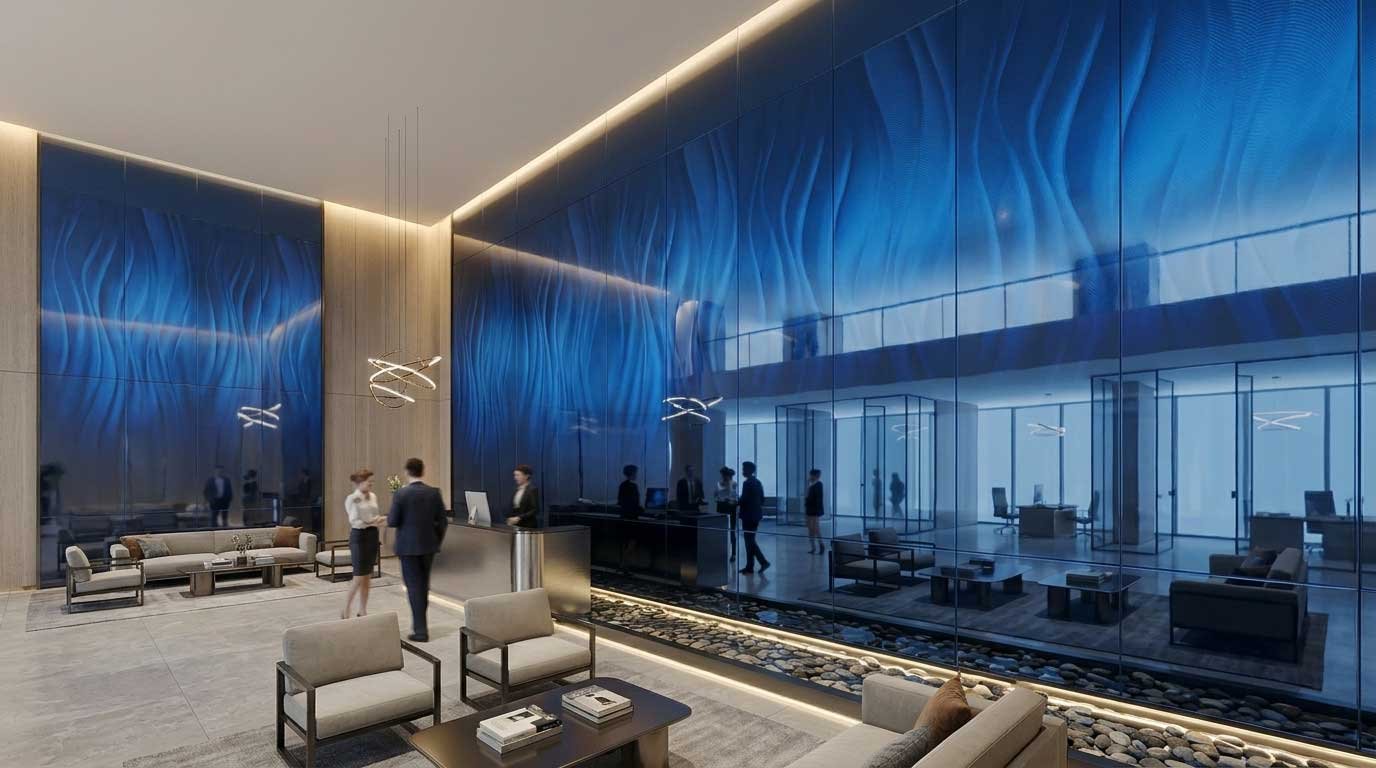
Feature walls in luxury hotel lobbies, elevator cars and elevator landings
Stainless steel laser etched panels are a common pick for reception backdrops, elevator side panels and lift lobby walkways. They bring that high-end, futuristic feel straight away. Elevator cabins are tight spaces, and guests stand close to the walls. The fine CD texture catches light differently as the lift goes up and down. This changing glow makes the ride more interesting and takes away that cramped feeling.
High-end commercial showrooms, bar fronts and art installations
Designers use these laser panels behind shop display cases in flagship stores, to cover bar counters, or as art pieces in tech showrooms. They make great spots for photos. Use moving spotlights or colour-shifting RGB lights with them. The surface creates swirling light patterns, like soft nebulae or moving light streaks. Visitors love taking photos here and posting them on social media.
Entry screens, decorative room dividers and ceiling panels for private villas
For villa projects, designers often use laser etched stainless steel sheets as entrance screens, living room dividers or ceiling features. Light filters and reflects across the surface. This avoids the plain look you get with regular metal panels. It splits up rooms without cutting off light, and adds subtle artistic charm to the whole home.
Finishes and cabinet inserts for bespoke high-end furniture
Light-luxury metal furniture is really popular right now. Many premium furniture makers use 0.8mm laser etched stainless steel sheets. They put this material on sideboard doors, drawer fronts and coffee table tops. The fine texture, matched with neat metal trim, boosts the furniture’s value and gives it a great tactile feel.
How to Install Stainless Steel Laser-Etched Panels and Achieve Optimal Lighting Design?
Stainless steel laser-etched panels represent an “art of light and shadow,” and their final visual effect depends heavily on on-site installation standards and a scientifically sound lighting layout.
Smart lighting setup (“30% from the panels, 70% from the lights”)
How these laser etched stainless steel panels catch light depends heavily on your light fixtures. Keep these rules in mind when planning the install:
- Light angle: Wall wash spotlights need to sit some distance away from the wall, aimed at 30° to 45° onto the panel. This angle brings out bright, crisp refracted light. If you shine light straight on at 90 degrees, those light reflections won’t reach viewers, and the whole effect becomes much weaker.
- Light pick: Go for LED spotlights with high CRI, like COB lights. Stay away from wide, diffused light strips. Tighter point lights create sharper, more eye-catching light refractions.
- Color temperature matching: Warm white light at 3000K–3500K works best for bronze and titanium panels. It brings out their rich, luxurious tone. For black titanium and silver panels, use neutral white light at 4000K–5000K. This gives that clean, futuristic, cool look.
Base surface prep and neutral glue installation tips
- Base leveling: Walls need proper priming and smoothing. Use dense OSB or fire-resistant plywood as the backing. Sand the backing board flat. If the base is bumpy, the panel’s light refraction will warp and look off.
- Neutral glue bonding: Stick panels down only with neutral structural adhesive or neutral no-nail glue. Never use acidic glue. Acid fumes eat away the protective backing on the panels. They can even seep through and ruin the front PVD finish.
Key Points for Seam Control and Seamless Installation
To achieve a seamless, continuous light effect during large-scale installation:
First, require the manufacturer to perform “continuous layout production” during procurement to ensure that the CD patterns of adjacent panels align precisely at the seams; second, use high-precision fiber laser cutting to control seam widths to within 0.5 mm;
third, employ micro-seam tight-fitting or hidden snap-lock structures, and use color-matched neutral adhesive for extremely fine finishing.
Timing for Protective Film Removal and Finished Product Protection
Wait until all site work is done and the space is fully cleaned before peeling off the PE protective film on the panels. Pull the film steadily at a 45-degree angle. Don’t rip it hard, or you might scratch the nano anti-fingerprint top layer. While fitting the panels, keep hard items from hitting them, and stop cement splatters from landing on the surface.

Conclusion
In short, these high-end decorative panels merge precise micro-processing with modern optical aesthetics. Key selection factors are accurate micro-textures, flat substrates, proper PVD coating and suitable lighting. Far beyond ordinary metal sheets, they amplify space-based light-shadow effects.
Every detail influences results: checking 304/316L material and 0.8-1.5 mm thickness, picking PVD finishes (black titanium, antique bronze), applying AF anti-fingerprint coating, fitting 30°-45° spotlights, using proper-pH glue and seamless joints.
For luxury-grade projects, work with seasoned suppliers like JYF Metal. They deliver genuine laser-etched CD textures and advanced coatings, covering samples, drawings and precision production to bring your designs to life with dramatic light and shadow.
FAQs
Q1: Will dust get trapped within the fine CD-pattern grooves on laser-etched stainless steel panels? How should we maintain them daily?
If you get panels from a dependable producer, they are finished with nano anti-fingerprint treatment. This surface layer sheds water and oil, so fine dust won’t stick to the grooves easily. Maintenance is really easy. Do not use scouring powder, steel wool or harsh acid‑based/alkaline cleaning products. Take a soft micro-fiber cloth, moisten it with clean water or lightly thinned dish detergent. Wipe softly along the texture grain, then buff dry with another clean cloth, and the panels will look as good as new.
Q2: Why isn’t the installed panel producing that bright light effect we saw on the sample?
Bad site lighting is to blame in most cases, over 90% of the time. Wide diffused light strips or flat ceiling lights spread light too loosely, so you cannot get the desired refraction. Spotlights shining head-on at 90° also don’t work-the reflected light misses where people stand and view. Swap over to focused LED spotlights. Mount them away from the wall and tilt the light at 30°-45° onto the panel. This simple fix normally brings out the expected light show right away.
Q3: Can laser-etched stainless steel panels go onto outdoor builds? What do we need to watch out for?
They can be used for landscape features and sheltered walk-through areas. Corrosion resistance is the main concern outdoors. You have to go with 316L stainless steel. Pick sheet thickness of 2.0-3.0 mm, so panels hold firm and do not flex under wind force.
Q4: For large panel installations, how do we stop broken, disjointed light effects along panel joints?
Follow these three practical field tips. Ask your supplier to produce panels from the same raw coil batch. This keeps CD patterns matching across adjacent panels. Use fibre-laser cutting, to keep edges crisp and prevent warping. Fit panels with micro-gaps no wider than 0.5 mm, and fill joints with neutral-shade sealant. Get all these points right, and the whole wall will look like one unbroken surface.