Redefining Luxury: The Art and Engineering of Custom Stainless Steel Fabrications in Middle Eastern Fine Dining
Table of Contents
In the Middle East’s ultra-luxury restaurants and high-end lounges, the first impression upon entering a space determines the brand’s luxury positioning. Unlike the industrial style or minimalist monochromatic palettes favored in Europe and the United States, high-end dining spaces in the Middle East emphasize extreme visual impact, elegant metallic textures, and the modern reinterpretation of traditional Arab cultural symbols. Against this backdrop, custom stainless steel—refined through modern techniques such as PVD coating, water-wave embossing, and curved forming—has become an irreplaceable “star of luxury” in the hands of Middle Eastern interior designers.
As an industry expert specializing in metal solutions for high-end commercial dining spaces, JYF METAL has been deeply involved in and has witnessed the evolution of decorative stainless steel in Middle Eastern dining design. From Arabic geometric screens to dynamic rippled ceilings, from suspended wine racks to custom-shaped sculptures, decorative stainless steel not only embodies the pinnacle of spatial aesthetics but also tests manufacturers’ rigorous control over craftsmanship details and high standards of weather resistance.
Aesthetic Philosophy of Middle Eastern Dining
To understand the widespread use of stainless steel decor in Middle Eastern restaurants, one must first understand the region’s unique sociocultural context and philosophy of spatial design.
Privacy & Heritage
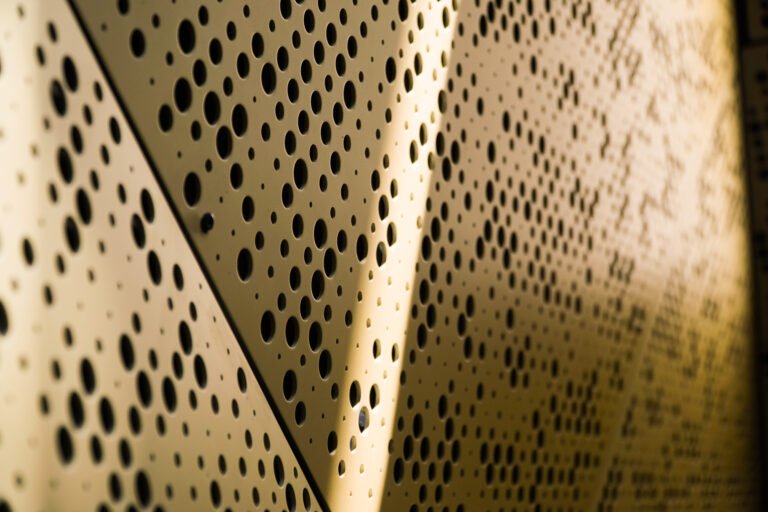
Middle Eastern social culture places great emphasis on the privacy of dining. High-end restaurants typically feature VIP private rooms, secluded booths, and separate social areas. Designers have reimagined traditional Arabic wooden latticework (Mashrabiya) as laser-cut stainless steel screens, which ensure the flow of air and light between areas while providing excellent screening and privacy.
Light & Element of Water
In arid desert environments, “water” symbolizes life, vitality, and supreme wealth. As a result, designers are particularly fond of using materials in interior spaces that reflect light and shadow and evoke a sense of fluidity. Mirrored stainless steel, rippled panels, and metal walls accented with LED strip lighting have become the ideal mediums for creating a “glistening water” effect indoors.
Opulent Color Palettes
Unlike the natural color of stainless steel, the Middle Eastern market has a strong preference for colored stainless steel. Champagne gold, yellow gold, black titanium, and rose gold are the dominant colors. These hues lend the metal a warm, elegant vitality and create a perfect material contrast with luxury stone, marble, and handcrafted velvet.
7 Core Applications of Decorative Stainless Steel
In large-scale luxury restaurant projects in the Middle East, stainless steel accents are not scattered haphazardly but rather form a cohesive spatial logic that extends from floor to ceiling and from walls to furniture.
Mashrabiya & Booth Screens
In the main dining hall and booth areas of the restaurant, striking a balance between a sense of openness and privacy is the core design challenge. Stainless steel partition screens play an irreplaceable role in this regard.
Craftsmanship Details: Typically, 304 or 316 grade stainless steel sheets are used, which are precision-cut using high-precision fiber laser cutting to create complex octagonal stars, beveled geometric patterns, or intertwined botanical motifs. To create a three-dimensional effect, the screens are often constructed from double- or triple-layered stainless steel frames with laminated glass or translucent acrylic sandwiched between them.
Surface Finishes: Brushed champagne gold or mirror black titanium. The brushed finish helps prevent fingerprint smudges, while the mirror-finished edges enhance light refraction.
Water Ripple Ceilings
When you step into a top-tier luxury restaurant in the Middle East, you’ll often look up to see a metallic ceiling that ripples like the surface of water.
Applications: Central ceiling of the restaurant’s main hall, corridor ceilings, and above the water bar.
Manufacturing Process: Mirrored stainless steel water ripple sheets are used. Hydraulic or stamping techniques are employed to create large, medium, or small ripples of varying depths on the sheet’s surface.
Interplay of Light and Shadow: Thewater ripple panels themselves do not emit light, but their unique curved surface structure causes light from floor sources, candlelight on tables, and concealed light strips to be diffusely reflected in an irregular pattern. This makes the entire ceiling appear like flowing water, greatly enhancing the restaurant’s sense of ceiling height and spatial depth.
Bar Counters & Overhead Racks
The bar and beverage counter areas are the restaurant’s most profitable and popular sections, and they also serve as a showcase for the highest level of metalworking craftsmanship.
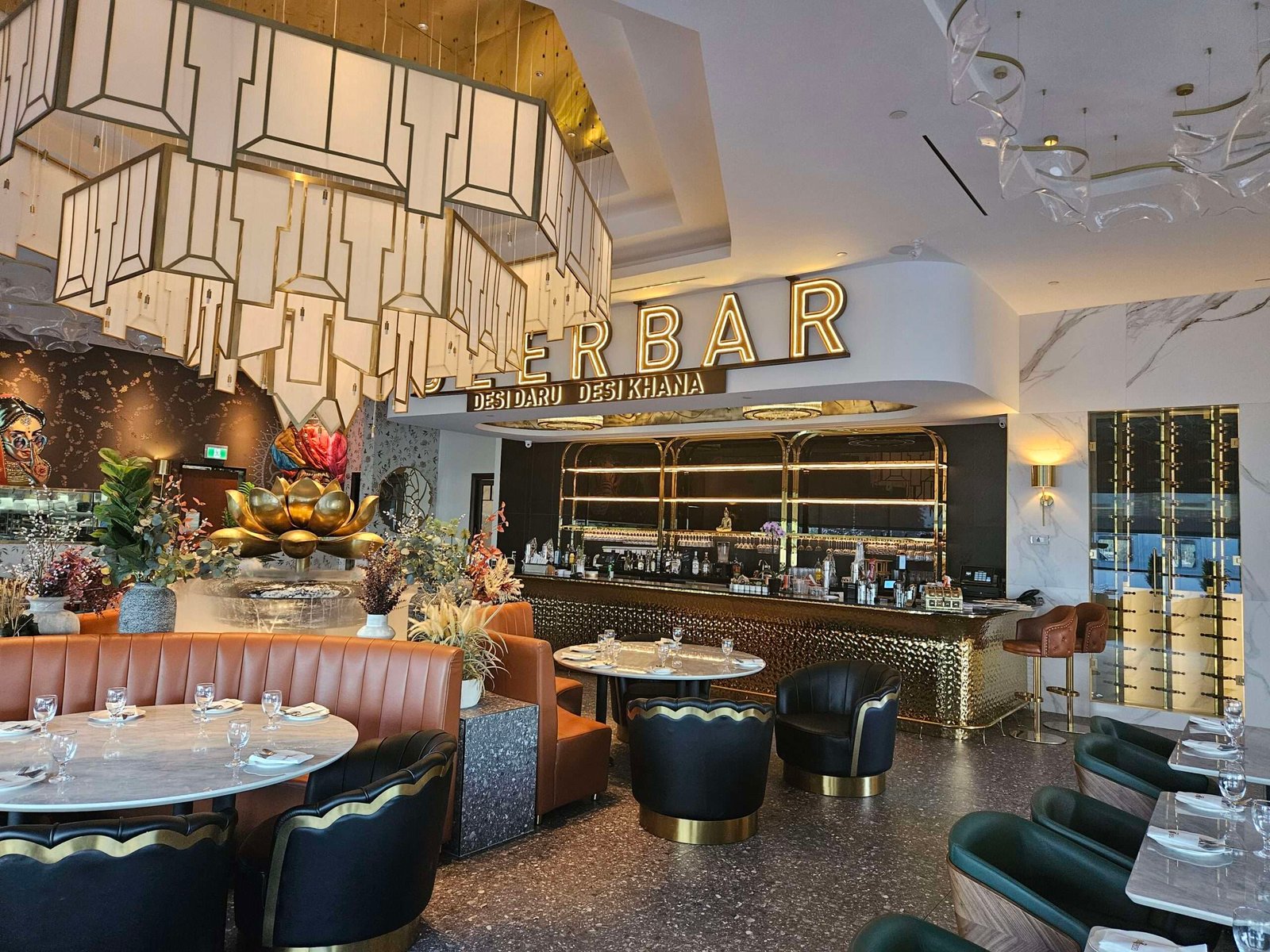
Bar Counter Body: The front of the bar counter often features embossed stainless steel panels, thermally curved stainless steel, or titanium-coated metal frames combined with translucent luxury stone. The wine cabinets behind the bar make extensive use of thin stainless steel frames and concealed LED light channels.
Overhead Bar Rack: Metal wine racks suspended above the bar counter are typically massive in scale and must be directly secured to the building’s structural steel framework. These racks are precision-welded from stainless steel square or round tubing, paired with laser-cut metal grids or shelves. Stainless steel overhead wine racks must not only support the weight of hundreds of bottles of fine wine and crystal glasses but also feature seamless joints with no exposed screws, achieving a mirror-like finish after PVD coating.
Custom Sculptural Centerpieces
In the entrance halls or central display islands of high-end restaurants in the Middle East, striking stainless steel sculptures are often prominently displayed.
Form Characteristics: These sculptures typically feature streamlined shapes, abstract plant forms, desert sand dunes, or the fleeting form of dripping liquid metal.
Manufacturing Techniques: The production of these custom-shaped sculptures involves 3D modeling, hand hammering, seamless welding and grinding, and mirror polishing. These sculptures require an absolutely smooth, flawless surface—resembling molten mercury—and serve as a key indicator of the workshop’s expertise in both hand-finishing and digital modeling.
Wine Cabinets & Buffer Systems
High-end dining in the Middle East places great emphasis on the customer experience, which extends beyond mere visual appeal to include tactile sensations and subtle auditory details.
In these stainless steel wine cabinets, cigar cabinets, buffet counters, and storage and display systems—all crafted specifically for top-tier restaurants—JYF METAL has extensively integrated high-specification stainless steel damping and soft-closing systems into their structural designs. Whether it’s heavy glass-and-stainless-steel cabinet doors or sliding display drawers, they all achieve ultimate silence and smooth, shock-absorbing motion the moment they are pushed, pulled, or closed. This “silent, smooth” mechanical quality eliminates the noise of clattering tableware and significantly enhances the sense of luxury and prestige within the space.
Column Cladding & Wall Panels
The facade serves as the main stage for large-scale stainless steel installations.
Column Cladding: Concrete load-bearing columns in large restaurants often appear bulky. By fully cladding them with curved, hot-bent stainless steel sheets or polygonal, folded stainless steel panels—combined with concealed vertical lighting channels—these once-obtrusive structural elements can be instantly transformed into towering columns of light that reach toward the sky.
Wall Panels: Stainless steel wall panels are rarely used on their own; instead, they are combined with materials such as marble, high-end leather, and glass bricks. When used as dividing frames or background panels, stainless steel lends a strong sense of modern technology to the interplay of different materials.
Ceiling & Wall Edge Trims
Perfect design is often hidden in the most inconspicuous corners.
Edge Trims & Skirting: Stainless steel T-profiles, L-profiles, channel-shaped trim strips, and custom baseboards are widely used at the junctions between ceilings and walls, in the transition zones between marble floor tiles and wall panels, and along baseboard lines.
Quality Considerations: Although these metal trim pieces have small cross-sectional dimensions, their total length is extremely long. The factory must ensure exceptional straightness, consistent plating color without any color variation, and seamless joints at 45-degree angles.
Engineering & Fabrication Standards in the Middle East
The unique geographical conditions of the Middle East, combined with top-tier engineering standards, place extremely demanding requirements on the fabrication of stainless steel decorative products.
| Evaluation Criteria | Technical Specifications and Standards | Practical Requirements for the Middle East Market |
|---|---|---|
| Base Material | AISI 304 / AISI 316 / 316L | High-quality 304 stainless steel is used in standard indoor areas; in coastal regions (such as Jumeirah Coast in Dubai and Port of Doha) or hot and humid areas (such as around water features and open-air bars), the use of 316/316L salt-fog-resistant stainless steel is mandatory. |
| Color Coating | PVD coating (Physical Vapor Deposition) | The use of ordinary spray paint, which is prone to peeling and fading, is strictly prohibited. The PVD coating process must be used, with a coating thickness in the micrometer range, to ensure that the color does not fade and the coating does not peel off even after decades of exposure to intense ultraviolet radiation. |
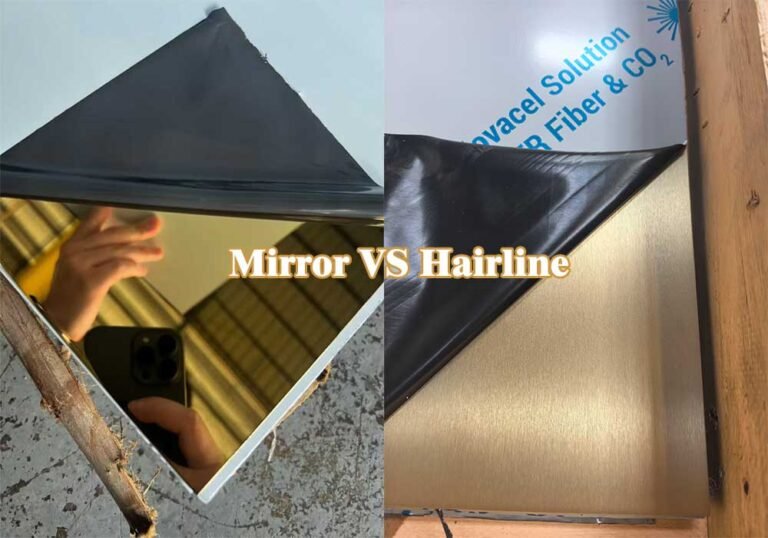
| Surface Finish | 8K Mirror, Hairline, Sandblasted, Etched | Supports 8K mirror, anti-fingerprint hairline, sandblasted, and etched composite finishes. The surface must be coated with a nano-anti-fingerprint protective layer to reduce daily cleaning and maintenance costs in restaurants. |
| Welding Standard | TIG / Laser Welding & Seamless Grinding | All exposed weld seams must be fully penetrated and precision-ground; the surface must be free of any visible weld spots, undercut, or discoloration, and must exhibit completely uniform metallic continuity after titanium plating. |
| Hardware Integration | Stainless Steel Buffer & Soft-close Hinges | Cabinet bodies and moving parts must be equipped with a corrosion-resistant stainless steel damping buffer system, and must pass fatigue testing with over 100,000 cycles of smooth, fault-free opening and closing. |
End-to-End Quality Control from Design Blueprints to On-Site Delivery
A successful metal fabrication project for a high-end Middle Eastern restaurant depends not only on the stunning design but also on the precision of the detailed engineering and the perfection of the on-site installation.
Shop Drawings & BIM
Transforming the architect’s conceptual renderings into construction-ready drawings. Using 3D modeling software to perform stress analysis and modular design for complex, irregularly shaped sculptures and suspended wine racks.
Color Proofing
Clients in the Middle East are extremely sensitive to the shade of “gold” (too yellow appears tacky, while too light lacks a sense of luxury). The factory must provide physical samples in various shades, such as champagne gold and rose gold, and verify and compare them under LED lighting with different color temperatures.
Pre-assembly & Testing
Before shipment, suspended wine racks, screen panels, and cabinet bodies equipped with damping systems must undergo 1:1 pre-assembly at the factory. Joint gaps, the smooth operation of hardware, and structural load-bearing safety are inspected to ensure zero-defect shipments overseas.
Packaging and Shipping Protection
Color-coated stainless steel mirror panels are extremely fragile. The product surfaces must be covered with high-density protective film and packed in fully enclosed export-grade wooden crates lined with foam and desiccants to ensure they arrive intact during international sea transport and in the high-temperature transport conditions of the Middle East.
Conclusion
In the Middle East—a land brimming with ambition and creativity—dining spaces have long transcended the single function of “eating,” evolving into comprehensive experiential venues that encompass visual art, cultural expression, and high-end socializing. From geometric openwork screens imbued with Islamic charm to graceful, rippling artistic ceilings; from grand, imposing suspended wine racks in bars to stainless steel cabinets with damping mechanisms where every detail exudes elegance—custom stainless steel decor forms the visual framework and luxurious soul of high-end restaurants in the Middle East.
Creating stainless steel works that combine artistic beauty with engineering durability requires a deep understanding of the material’s properties and an almost obsessive attention to manufacturing details. As an expert in metal solutions for commercial dining spaces, JYF METAL remains committed to deeply integrating advanced stainless steel manufacturing techniques, precision damping hardware systems, and cutting-edge design aesthetics to craft luxurious spatial masterpieces that stand the test of time for top-tier restaurants worldwide and across the Middle East.