2026 Architectural Decor: In-depth Comparison of 304 vs. 316L Stainless Steel Corrosion Resistance in Various Environments
Table of Contents
Don’t Let “Rust” Ruin Your Million-Dollar Project.
In 2026, the “durability” of building materials has become a core standard for sustainable construction. Whether it’s a desert landmark in Dubai or a waterfront hotel in Singapore, designers’ requirements for metal finishes have evolved from “aesthetics” to “extreme weather resistance.”
However, in our daily business, we still encounter clients who, to save 20% on their initial budget, opt for 304 stainless steel in coastal projects—only to be faced with a landscape of rust spots just one year later. While 304 and 316L look nearly identical, their “immune systems” are worlds apart. As the technical team at JYF METAL, we will use this white paper to help you fully understand the significant value gap between these two grades.
The Power of Molybdenum (Mo)
Many people know that 316L is superior, but they don’t know exactly why. The key lies in that unassuming 2%–3% of molybdenum (Mo) in the chemical composition.
What is Pitting Corrosion?
In environments containing chloride ions (such as seawater, salt spray, and cleaning agents), the protective film on the surface of stainless steel can be locally breached. When faced with chloride ion attack, 304 is like a wall without sentries. However, 316L stainless steel contains the element “molybdenum,” which is like mounting automatic defensive weapons on the wall; it significantly improves the steel’s pitting resistance equivalent number (PREN) in acidic or high-salt environments.
What does the “L” stand for? Why will it be even more important in 2026?
The “L” in 316L stands for Low Carbon.
During complex irregular-shaped fabrication or thick-plate welding, standard stainless steel is prone to chromium carbide precipitation in the heat-affected zone, causing the welded area to corrode first. By limiting carbon content to less than 0.03%, 316L ensures that every weld in large-scale welding projects has the same corrosion resistance lifespan as the base material.

Key Specifications Comparison Chart (2026 Standard Edition)
To help purchasing managers quickly reference the information, we have compiled this comprehensive comparison chart of physical and chemical specifications:
| Property Dimensions | 304 Stainless Steel | 316L Stainless Steel | 2026 Selection Recommendations |
|---|---|---|---|
| Chemical Composition | 18% Chromium + 8% Nickel | 16% Chromium + 10% Nickel + 2% Molybdenum | 316L offers superior resistance to chloride ions |
| PREN Value (Pitting Resistance Equivalent Number) | Approx. 18–20 | Approx. 23–26 | Higher PREN values ensure greater stability in extreme environments |
| Carbon Content | ≤ 0.08% | ≤ 0.03% (Ultra-low carbon) | 316L is better suited for large-scale welding processes |
| Coastal environments (within 5 km) | High susceptibility to pitting corrosion | Excellent performance, long-lasting corrosion resistance | 316L is mandatory for coastal projects |
| Dry indoor environments | Best value for money, perfectly suitable | Overkill in performance, higher cost | 304 is the top choice for interior decoration |
| High-Temperature Resistance / Industrial Acid Rain | Average | Strong (better oxidation resistance) | Select 316L for heavy industrial zones or chemical projects |
| Magnetic Properties | Non-magnetic / Weakly magnetic (after processing) | Extremely weakly magnetic / Non-magnetic | 316L exhibits more stable magnetic properties |
| Initial Cost Estimate | Base price 100% | Approx. 135% - 150% | Long-term maintenance costs must be considered |
Global Real-World Scenarios: Material Selection Across Different
Scenario 1: Commercial Centers in Inland Cities (e.g., Xi’an, Madrid)
In dry inland cities with extremely low salt fog levels, 304 stainless steel is the clear choice for value.
Applications: Indoor baseboards, elevator cabins, accent walls.
Risks: The only threat comes from improper cleaning methods. If cleaning staff use acidic tile cleaners and fail to wipe the surface dry promptly, 304 stainless steel will still suffer chemical corrosion.
Scenario 2: Tropical, high-humidity rainforest climate (e.g., Singapore, Bangkok)
Even away from the coast, high humidity can cause metal surfaces to remain in a state of condensation for extended periods.
Selection: We recommend 316L for outdoor use and 304 for indoor use.
Reason: Prolonged exposure to humid environments accelerates electrochemical corrosion; the stable oxide layer of 316L helps reduce surface fogging caused by fluctuations in humidity.
Scenario 3: Prime beachfront locations (e.g., Jumeirah in Dubai, Sydney Harbor)
This is a “no-go zone” for 304.
Material Selection: 316L or higher grades are mandatory.
Challenge: Salt carried by sea breezes accumulates in the decorative textures of stainless steel (such as brushed finishes). In this environment, 304 typically develops yellowish-brown rust spots within 3–6 months, whereas 316L can remain as good as new for years.
Scenario 4: Basements and Heated Swimming Pools (High-Chlorine Environments)
This is a hidden high-risk area.
Warning: Heated swimming pools release large amounts of chlorine for disinfection, while basements typically have poor ventilation and high salinity levels.
Recommendation: For any projects involving pool handrails or basement trim, be sure to upgrade to 316L stainless steel; otherwise, the cost of renovation will be exorbitant.
Latest Maintenance Cost Logic for 2026 (LCC Analysis)
As a professional stainless steel supplier, we help our clients calculate the “Life Cycle Cost (LCC).”
Let’s consider a 1,000-square-meter stainless steel curtain wall project:
Initial Purchase: 316L costs $150,000 more than 304.
Five-Year Maintenance:
- 316L requires only periodic rinsing with clean water, resulting in extremely low costs.
- 304 develops rust spots, requiring chemical rust removal, polishing, and reapplication of anti-fingerprint treatment—and cannot be restored to its original condition. Maintenance costs over five years may exceed $200,000.
Ten-Year Conclusion: The total cost of ownership for 304 typically exceeds that of 316L by the seventh year.
Conclusion: 316L is not more expensive; it simply converts future maintenance costs into present-day reliability.
“Secondary Damage” to Corrosion Resistance Caused by Processing Techniques
This is factory-level expertise. Even if you purchase 316L stainless steel, it will still rust if proper processing techniques are not followed.
The Impact of Surface Roughness
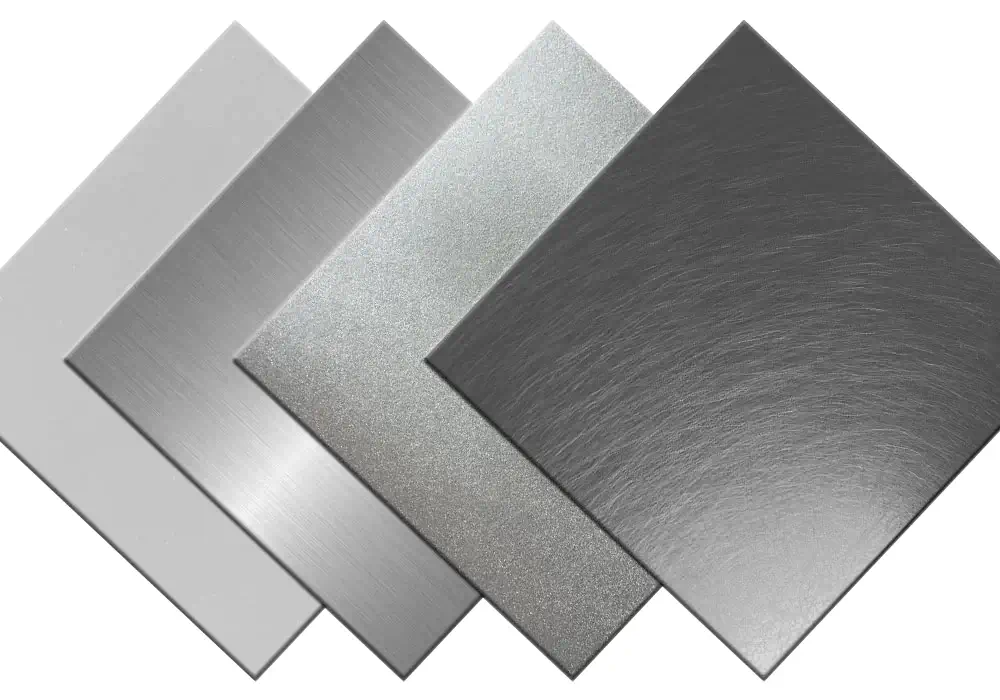
Experiments have shown that mirror-polished surfaces offer better corrosion resistance than hairline-finished surfaces.
Principle: The grooves on a hairline-finished surface can accumulate salt and moisture, forming micro-corrosion cells. If your project is located near the coast, we recommend applying a “passivation” treatment to the hairline finish, or simply opting for a high-precision mirror finish.
Post-Welding Treatment
Welding alters the local microstructure of stainless steel.
Key Steps: After welding 316L, acid pickling and passivation or thorough grinding and polishing must be performed to manually re-establish the protective oxide layer. JYF METAL performs rigorous anti-corrosion treatment on welds prior to shipment.
Conclusion
Let the material blend into its surroundings; let the design stand the test of time.
The pinnacle of stainless steel design lies in achieving a harmonious balance between the material and its environment. 304 isn’t “inferior”—it simply needs to be used in the right context; 316L isn’t “expensive”—it reflects a respect for extreme environments.
At JYF METAL, we are committed to doing more than just selling you sheets of metal; we provide you with a comprehensive environmental adaptation solution. If your project faces complex geographical challenges, please contact our engineering team—we will tailor the most suitable material solution specifically for you.