Luxury Hotel Ceiling Design Guide: Creating Premium Spaces with Custom Stainless Steel Ceiling Panels
Table of Contents
In the design context of modern luxury hotels, the ceiling is often referred to as the “fifth wall” of a space. Whether guests are stepping into the lobby or relaxing in their rooms, the ceiling is the most unavoidable focal point. The large swaths of generic white latex-painted drywall commonly used in the past no longer meet the demands of luxury spaces for an immersive experience.
Today, custom stainless steel decorative panels are taking over ceiling design in high-end hotels. Selecting a ceiling system is by no means merely a matter of purchasing the underlying framework; rather, it is a decision-making process that involves considerations of “aesthetic artistry” and “material craftsmanship.”Drawing on a professional perspective of high-end decorative stainless steel cladding, this article will provide an in-depth analysis of how precise control over cladding craftsmanship, texture, and system interfaces can create customized ceiling solutions for hotels that combine visual impact with long-term durability.
Materials and Surface Finishes: The “Visual Language” of Ceilings
Stainless steel cladding offers exceptional hardness, Class A1 fire resistance, and virtually permanent corrosion resistance. When subjected to specific mechanical processing or chemical coloring, it can evoke entirely different spatial atmospheres:
Mirror Finish (8K)
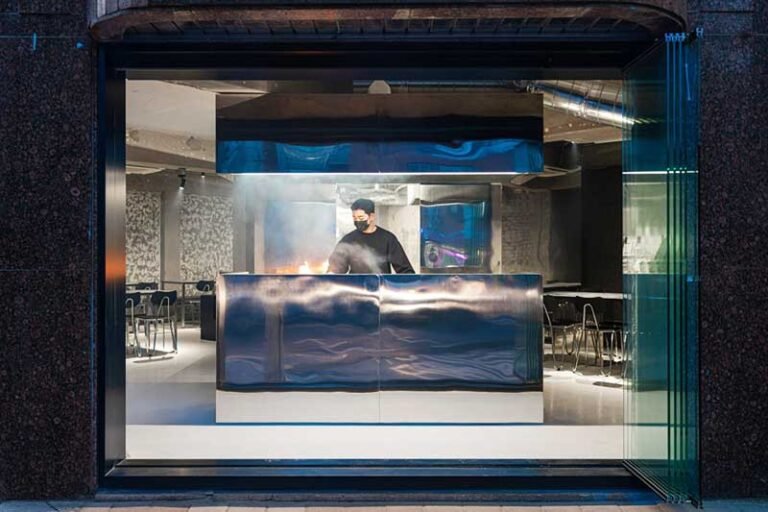
Through a multi-step mechanical polishing process, the stainless steel surface achieves a mirror-like clarity and reflectivity. In hotel bars, elevator lobbies, or corridors with relatively low ceilings, installing large-scale or partial mirrored stainless steel ceilings can create a powerful visual expansion effect. This extends light sources from the floor and walls, as well as soft furnishings, upward, creating a magical space where reality and illusion intertwine.
Stainless Steel Water Ripple Panels
This has become the “secret to success” in high-end luxury hotel design in recent years. Using heavy-duty dies to stamp, vacuum-form, or cold-roll the stainless steel surface creates a rippled texture reminiscent of a gentle breeze across a lake or water droplets spreading out. These are typically categorized into large ripples, small ripples, and flowing water patterns. When used as ceiling cladding, paired with linear wall-washing lights or recessed spotlights on the floor, they transform a once-stiff ceiling into a constantly shifting play of light and shadow, imbuing the space with powerful dramatic tension.
Hairline & Vibration
The brushed (HL) finish features fine, continuous straight lines, exuding a strong sense of modern, orderly beauty; whereas the random-pattern finish is created by the irregular rotation of the grinding head, forming a dense, random pattern of fine loops on the surface. The greatest advantage of random-pattern stainless steel ceilings lies in their gentle, diffuse reflection of light, which prevents glaring glare. They are also highly resistant to minor scratches and fingerprints during installation, making them a popular choice for lobby reception areas or the domed ceilings of high-end restaurants.
Laser Perforated Panels
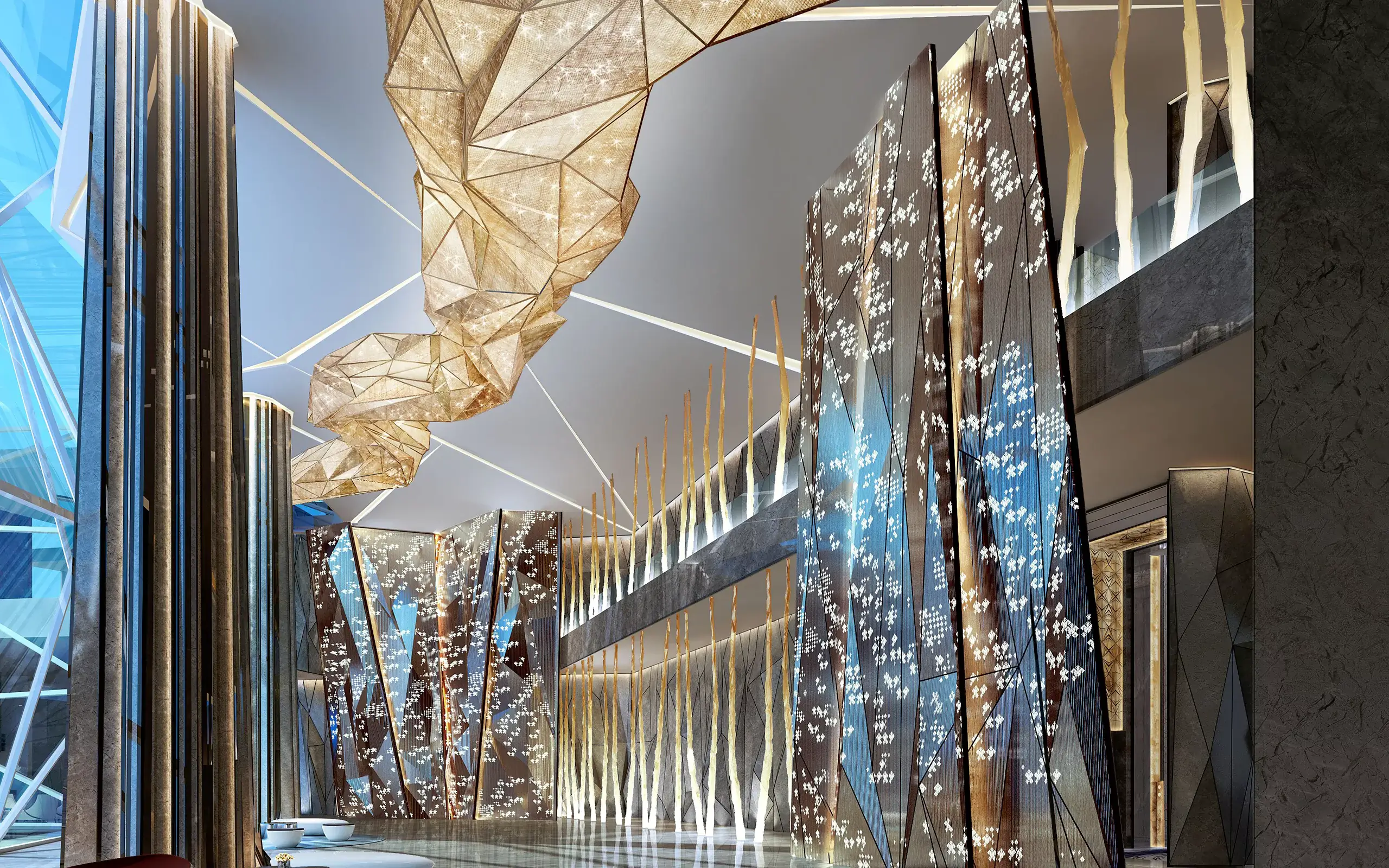
Through high-precision laser cutting, geometric lines or gradient patterns are precisely etched onto the surface of stainless steel, giving the rugged metal a light, semi-transparent visual texture reminiscent of fabric. When concealed light sources are distributed across the top, the cold surface instantly transforms into a light filter, casting a captivating play of dappled light and shadow. At the same time, it serves as a natural “acoustic permeable layer,” seamlessly concealing air conditioning vents and fire sprinklers within the pattern while allowing noise to pass through the micro-pores and be absorbed by the underlying acoustic foam. This perfectly fulfills the dual requirements of high-end spaces: “visual minimalism and acoustic invisibility.”
A Detailed Comparison of PVD Coating and Powder Coating
To enable architects and engineering procurement teams to easily compare and select options at a glance, the following table summarizes the stainless steel decorative cladding materials, visual effects, and system compatibility for key areas of luxury hotels:
| HOTEL AREAS | FUNCTIONAL REQUIREMENTS | RECOMMENDED FINISHES | FINISHING TECHNIQUES | CONSTRUCTION COORDINATION |
|---|---|---|---|---|
| Lobby | Elegant, luxurious, cohesive, no overly dense seams, and exceptionally smooth | Large-format stainless steel honeycomb panels (thickness ≥15 mm) | Brushed black titanium, chemically tinted champagne gold, nano-coating for fingerprint resistance | The edges of the panel feature high-precision CNC-machined folded edges and tongue-and-groove joints, ensuring perfect compatibility with standard close-fit, suspended light-gauge steel stud systems. |
| Ballroom | Top-tier acoustic insulation, combined with intricate lighting and air vents, and a large-span design | Artistic perforated stainless steel sheets | Matte brushed, matte sandblasted | The facing material serves as an “acoustic permeable layer”; openings for lighting fixtures and fire sprinklers are pre-cut, and the material is secured to standard studs with bolts through folded edges on all sides, with acoustic foam backing. |
| Dining & Lounges | Mood enhancement, atmospheric appeal, cross-material design, and ease of maintenance for future utility line inspections | Stainless steel water ripple sheets / Custom stainless steel vertical panels | Mirror-finish water ripples, heat-transfer wood grain, hand-rubbed antique bronze finish | The ripple panels are secured to the substrate using adhesive or back-mounted fasteners; the hanging panels feature standard snap-fit flanges that snap directly into universal notched battens. |
| Guest Rooms | Ultra-quiet, warm and refined, avoiding coldness, with a focus on the smallest details | Embedded stainless steel profile strips / Narrow decorative trim strips | Champagne gold with a random pattern, ultra-fine brushed finish | Featuring a two-wing design with dovetail grooves, it fits seamlessly into drywall joints and bonds perfectly with joint compound to prevent cracking at the edges of latex paint. |
| Wet Areas | Extremely high resistance to chloride corrosion, prevents condensation, eliminates pool echoes, and ensures high safety | High-performance corrosion-resistant stainless steel sheets (such as SUS316L) | Mirrored surface (reflecting the water's color), micro-perforated acoustic surface | The panel design features reverse drainage channels to prevent condensation buildup and is mounted on a heavy-duty corrosion-resistant (hot-dip galvanized) framing system procured by the project owner. |
The “Gold Standard” of Quality Control: Overcoming Challenges in Luxury Hotel Projects
High-end hotel projects have zero tolerance for material defects. To ensure that ceilings maintain their flawless appearance under prolonged exposure to light, we have established a comprehensive, closed-loop quality control system that spans the entire process—from raw materials to finished products—with dedicated personnel assigned to each stage:
Sourcing and Surface Finishing
We exclusively use high-precision steel sheets from the same furnace batch at China’s leading steel mills to eliminate impurities in the base material from the source. Whether it’s mirror finish, ripple finish, or chemical coloring, each batch undergoes micron-level film thickness control and comparison by experienced color-matching artisans under standard lighting conditions. This ensures a color difference of ΔE < 1.0, completely eliminating the “shading” effect that can occur after large-scale installation.
Surface Coating and Precision Machining
Immediately after the surface treatment is completed, the parts are transferred to an automated lamination line, where protective film of a custom thickness is applied to prepare for subsequent processes. During the subsequent cutting, bending, V-grooving, and laser cutting processes, a process technician performs 100% inspection.
Welding, Grinding, and Final Inspection
For edge joints or irregular corners in ceiling panels, highly skilled welders perform micron-level precision welding. The welds undergo multiple rounds of manual grinding and polishing, starting with coarse and progressing to fine, ensuring they blend seamlessly with the texture of the surrounding panels. Before each finished product leaves the factory, a dedicated inspector conducts a final review of flatness, dimensional tolerances, and mounting interfaces.
It is this level of physical oversight—from “raw materials, surface finishing, and lamination to cutting, bending, planing, laser cutting, welding, and grinding”—carried out by dedicated specialists that gives us the confidence to help our engineering partners flawlessly bring the “fifth wall” of luxury hotels to life.
Conclusion
Traditional structural engineering firms provide a sturdy framework, while cladding suppliers are responsible for dressing this framework in the most exquisite “bespoke attire.”
We do not offer standardized light-gauge steel framing services, but we specialize in the texture and color ofstainless steel surfaces and have a dedicated team of technical detailers. We work closely with owners, architects, and contractors to develop detailed panel edge and joint designs based on specific project drawings, ensuring that high-end decorative stainless steel panels are seamlessly installed on standard ceiling structures. Please contact us to request our latest catalog or to request a custom sample!