The Art of Hand-Hammered Metal: A Deep Dive into Texture, Materials, and Craftsmanship
Table of Contents
In today’s world, where Industry 4.0 is sweeping the globe, we are surrounded by industrial products with precise lines and smooth surfaces. However, in the realm of high-end architectural decoration, an ancient yet dynamic material is making a comeback—the Hammered Metal Panel.
Whether in high-end private clubs in Dubai or flagship stores of top brands in London, designers are increasingly drawn to textures that carry the “warmth of craftsmanship.” Hammered metal panels are not merely a finishing material, and they are a shaper of light and shadow, a visual rhythm that metal unleashes under the hammer’s strike. This article will take you deep into the logic behind this material, helping you understand why some hammered metal panels cost only a few hundred yuan per square meter, while others cost thousands.
Choosing Materials: Stainless Steel vs. Copper
The most common hammered panels on the market are primarily made of stainless steel and copper. Although they appear to be merely surface textures, the distinct physical properties of these materials result in vastly different artistic effects.
Stainless Steel Hammered Panels: The Rhythm of Liquid Metal
Stainless steel is extremely hard, which means that creating deep, distinct patterns on its surface requires greater force and more precise control than with copper.
- Physical Properties
Stainless steel sheet exhibits significant “work hardening,” meaning that with each strike, the metal’s atomic structure rearranges, becoming even harder.
- Visual Appeal
When hammered textures are combined with an 8K mirror finish, stainless steel panels no longer resemble metal. Instead, they evoke the rippling surface of a lake in sunlight or flowing liquid mercury. This cool, avant-garde texture is the perfect complement to modern architectural styles (such as Minimalism and Futurism).
- Material Grade
JYF METAL recommends that in high-salt-fog environments, such as coastal areas or around swimming pools, 316L grade must be selected to ensure that moisture accumulation does not cause oxidation spots to form in the depths of the hammered texture. Generally, 304 stainless steel is the standard choice.
Copper and Brass Hammered Sheets: The Soul of an Ancient Craft
Copper is the metal that has been used the longest in human civilization and is also the most suitable for hand-hammering.
- Ductility
Copper possesses exceptionally malleable and pliable physical properties. This allows artisans to hammer out deeper, more three-dimensional indentations.
- The Vitality of Color
Copper sheets not only gain a sense of depth through hammered textures but can also undergo chemical antiquing processes (Antique Finish) to produce hues ranging from verdigris and red patina to even black gold. Hand-hammered textures allow these aged hues to create natural transitions in depth across the surface’s undulations—a sense of layering that flat sheets can never replicate. Moreover, as time passes and copper oxidizes in the air, it develops an even more distinctive antique charm.

A Clash of Techniques: Machine Stamping vs. Hand-Hammering
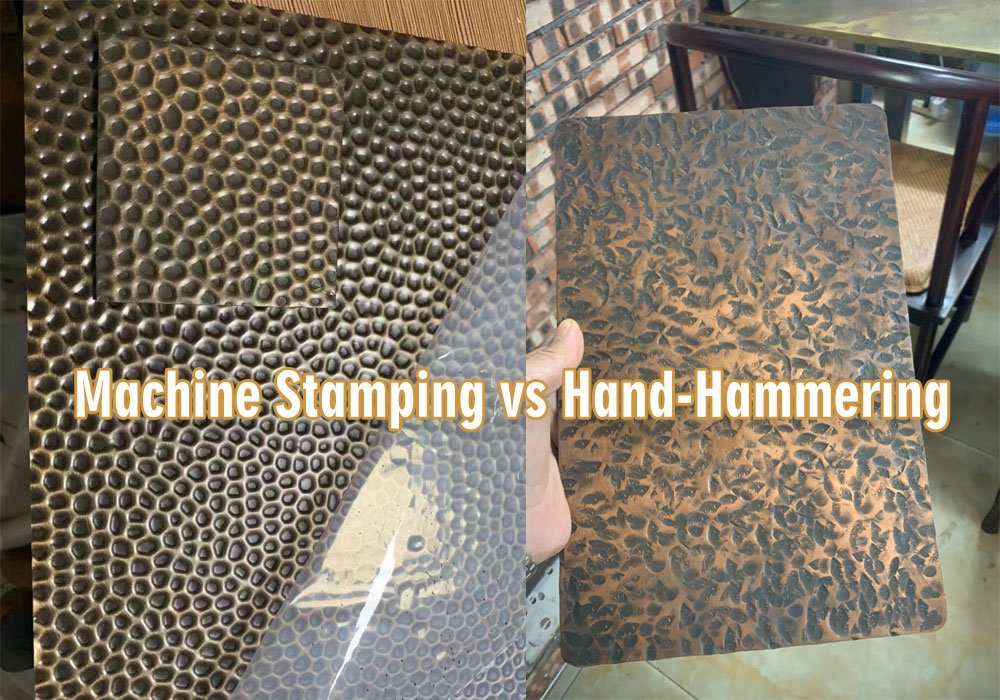
Many customers ask when inquiring, “Why is your price several times higher for the same honeycomb pattern?” The key difference lies in the production method.
Machine Stamping: Order and Efficiency
Machine stamping uses pre-made dies and heavy-duty presses to form the pattern on the sheet material in a single press.
- Characteristics
The pattern is extremely uniform, with every honeycomb pattern having identical size, depth, and spacing.
- Advantages
Extremely high production efficiency and low cost, making it suitable for large-scale ceiling projects viewed from a distance.
- Disadvantages
Visually somewhat rigid and lacking “soul.” Due to the fixed dies, it is impossible to achieve gradient textures or irregular patterns.
Purely Hand-Hammered: Irreplicable Artistry
This is the “haute couture” of metal craftsmanship. Artisans use hammers of various shapes to strike the metal sheet tens of thousands of times.
- Characteristics
“Uniqueness.” Every hammer mark is irreproducible, with textures that are irregular yet rhythmic, varying in depth, and featuring interlacing edges.
- Advantages
Highly artistic appeal. When illuminated, the refracted light from hand-hammered textures is non-directional, creating a very soft and detailed effect.
- Disadvantages
Long production cycle and extremely high labor costs. A single piece of finely crafted hand-hammered sheet metal may require a master craftsman to hammer continuously for several days.
The Evolution of Textures: Moving Beyond the Narrow Perception of “Honeycomb Patterns”
Although “honeycomb patterns” dominate the market, the potential of hand-hammered textures extends far beyond this. By varying the geometry of the hammer head, artisans can create an infinite array of textures.
Classic Honeycomb: The most recognizable pattern, created by striking with round or hexagonal hammers, it delivers a powerful visual impact.
Raindrop Texture: Using a small, pointed hammer, this technique produces extremely fine and shallow indentations. This texture is particularly pleasing to the eye up close and is often used for countertops in luxury retail boutiques.
Linear Flow: Craftsmen use long, narrow hammers to strike in a single direction, creating a flowing effect reminiscent of waterfalls or tree rings.
Volcanic Craters: Deep, wide pits are created using immense force, with a rugged texture inside. This style is often used to achieve a rugged industrial or raw, natural aesthetic.
Project Selection Recommendations: Balancing Budget and Aesthetics
As a client or contractor, how should you make your selection?
If your project involves suspended ceilings at heights of 10 meters or more: We recommend choosing mechanically stamped panels. From a distance, the intricate details of handcrafted panels are difficult to discern with the naked eye; conversely, the uniformity of stamped panels creates a clean, industrial aesthetic while significantly reducing costs.
If your project involves elevator cabs, reception desk backdrops, or high-end display cases:
Be sure to choose hand-hammered panels. These are areas where the human eye focuses up close; the handcrafted texture instantly elevates the sophistication of the entire space and reflects the client’s taste.
Post-Installation Cleaning: The Ultimate Guarantee of Metal Longevity
Although stainless steel or copper hammered panels are durable, their unique textured surface means that post-installation maintenance directly affects the longevity of the decorative finish.
Cleaning Principles: Strictly Avoid Acids and Alkalis
This is a critical rule that every project manager must understand. Commonly available strong detergents, oxalic acid, or toilet cleaners contain highly acidic or alkaline properties.
- Corrosion Mechanism
The indentations on the surface of hammered panels easily trap liquids. If acidic or alkaline cleaners are used, the liquid will seep deep into the texture, rapidly destroying the PVD coating or the copper surface’s oxidation-resistant layer.
- Consequences
This chemical corrosion can cause mottling, discoloration, or even peeling of the coating on the metal surface. Due to the uneven texture of the hammered finish, this damage is nearly irreversible and cannot be repaired through simple on-site polishing.
Proper Care Procedures
- Dry Wiping
Use a microfiber cloth to dust the surface regularly.
- Mild and Neutral
If degreasing is necessary, use a neutral cleaner (such as dish soap diluted in warm water). Rinse immediately with clean water and dry thoroughly after wiping.
- Periodic Maintenance
Apply a specialized metal care oil every six months to enhance the metal’s luster and form a protective barrier that blocks oxygen.
Conclusion
At JYF METAL, we don’t just manufacture panels; we help designers bring their “artistic visions” to life.
Given the inherent unpredictability of hand-hammered textures, we offer a“Precision Prototyping”service. Based on project requirements, our master craftsmen create three sample panels with varying degrees of intensity and density for clients to choose from. This rigorous sample approval process ensures that the final production batch perfectly matches the designer’s original concept.
We firmly believe that every hand-hammered panel possesses its own unique character. Choosing JYF METAL means choosing craftsmanship that stands the test of time.